The oldest of gemstones used by mankind, amethyst was believed by the ancient Greeks to be a protection against drunkenness.
Amethyst was considered by the ancient Greeks to be a talisman that could prevent drunkenness. It occurs in a wide range of tones from deep purple to light lavender. Amethyst is purple quartz, and it is the most valuable of all the varieties of quartz. It is also the oldest of gemstones to be used by mankind. In Europe, personal adornments containing amethyst have been discovered in ruins dating back 25,000 years.
In Egypt, amethyst had been used since about 3100 B.C. in items such as beads, charms, and personal seals. It was also highly regarded by the ancient Greeks and Romans, and during the Middle Ages it decorated royal crowns and papal rings. It is recorded that the wife of King George III of England, Charlotte (1744-1818), purchased an extremely costly amethyst necklace. Since then, discovery of new mines in areas such as the Ural region of Russia, as well as increased production in Brazil, have caused prices to drop, making amethyst a gemstone that is currently affordable even in high qualities. Prices have become reasonable because even high-quality material is being mined in relatively large quantities.
The amethyst on the page to the right is a superb sample, possessing high transparency in spite of its deep purple color. Its beauty is enhanced by an expert polishing technique that takes advantage of internal refraction and external reflections, pleasing the eye with a balanced mosaic pattern of purple tones. These patches differ not only in tone, but also show a range of colors from bluish purple to reddish purple, appearing almost as if a mosaic of violet sapphires and pink rubies had been inlaid in the amethyst. It can be said that the essence of beauty in the color of a gemstone lies in this king of balanced three-dimensional mosaic pattern.
Amethyst is fashioned in a variety of styles such as cabochons, beads, carvings, and tumbled stones, in addition to faceted stones like the one seen in the photograph on.

Pendant, Gold
Amethyst 1 pc
Untreated
36.90 ct
Diamond 10 pcs 2.73 ct
Name of mineral : Quartz
Mohs hardness : 7
Refractive index : 1.544~1.553
Specific gravity : 2.66

Name of mineral : Quartz
Mohs hardness : 7
Refractive index : 1.544~1.553
Specific gravity : 2.66
CHARACTERISTICS BY COUNTRY OF ORIGIN
Amethyst is the purple variety of quartz, the crystalline from of silica that occurs throughout the world. It has a hardness of 7 and is a gemstone of superb durability. Because of the abundance of silica on the earth’s surface, gemstones with a hardness of 7 or greater are desirable- softer materials are subject to severe abrasion. Current major producers of amethyst are Zambia, Brazil, and Uruguay, each producing material with characteristic qualities. Although now depleted, amethyst was mined several hundred years ago in Idar-Oberstein, Germany, which has since become a pioneering cutting center of gemstones. Russia and Sri Lanka also produce amethyst.

Zambia
Zambia is a source of fine-quality amethyst, with full-scale production having started in the early 1980s. Zambian amethyst has a deep, attractive purple color. However, because it often contains inclusions and concentrations of color (called color banging or color zoning), cutters will improvise with angles and faceting styles to create as clean a stone as possible. Inclusions and saturation of color tend to differ by source due to differences in natural environmental conditions during the formation of gem crystals.

Brazil
There are many amethyst mines in Brazil. As with other gemstones, characteristics of the rough material digger from mine to mine, and quality varies. It is common to see material that is large but pale in color, as well as dark material that is lacking in brilliance. Citrine (yellow quartz) occurs in nature, but most of it is amethyst that has been heated, and much Brazilian amethyst is subjected to this treatment.

Uruguay
Amethyst from Uruguay, located south of Brazil, often exhibits an uneven distribution of purple, with much of the material showing characteristic color banding or color zoning. If colorless areas are visible when a stone is viewed face-up, the quality is judged to be poor, while a stone that is attractive when seen face-up it is valued highly even if colorless areas can be seen from other angles. The material is similar to the amethyst found in southern Brazil, providing a good example of why source characteristics should be based on geological regions rather than national borders
JUDGING QUALITY
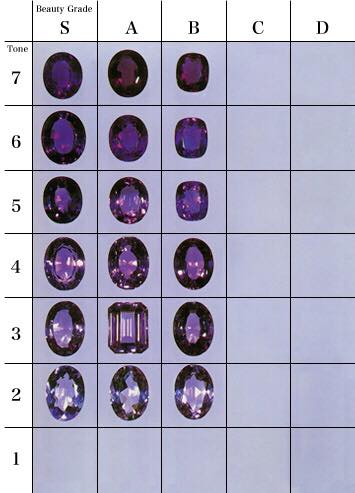
Amethyst is generally mined in large quantities. Material with a high level of transparency is fashioned into gemstones as shown in the quality scale.
Factors in judging the quality of amethyst are richness of color, level of transparency, color zoning, and the presence of eye-visible imperfections. Amethysts range widely from those of a very deep color to those that are quite pale. It is interesting to compare the darker tones to that of rhodolite garnet and the lighter tones to that of aquamarine. A pure purple, with no grayish or brownish tint, with a high level of transparency, and with a tone of 6 or a slightly dark 5 would be gem quality. Such a stone would possess substantial beauty.
On the chart to the next page, tones 7 to 5 are Zambian amethyst, and tones 4 to 2 are Brazilian.
QUALITY SCALE
AMETHYSTS
Untreated
HOW TO CHOOSE
Because amethyst is relatively inexpensive, it is especially advisable to purchase a stone of gem quality.
When Amethyst is set in jewelry with other gemstones a slightly light color is acceptable, but it may tend to look plain. The overall balance between design and workmanship becomes an important consideration. Overly dark stones with a tone greater than 7 tend to appear black under dim or evening lightning, and should be avoided.
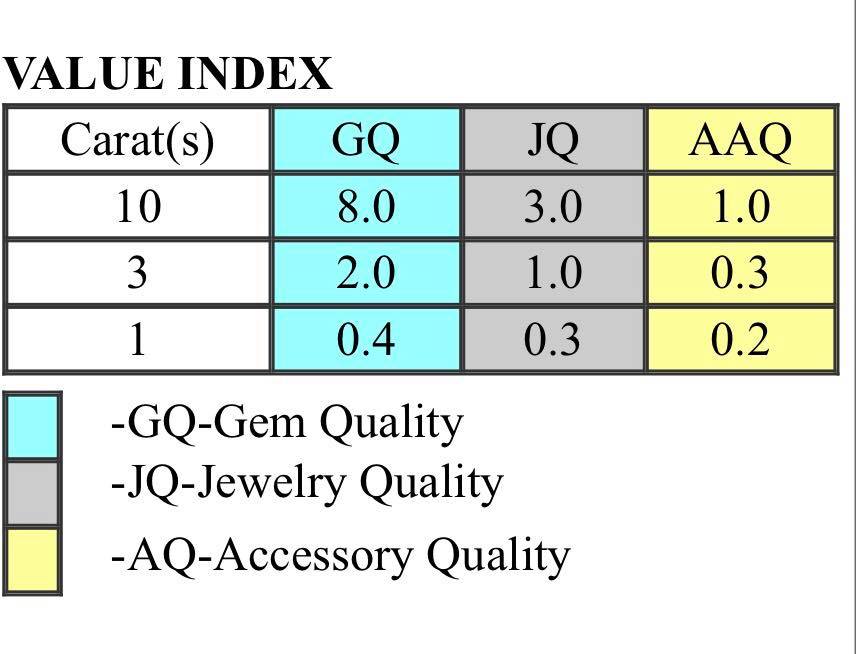
The value of a three-carat-size amethyst of jewelry quality is approximately US $160 for the stone alone (1998).

The 3 quality zones as they appear in the quality scale
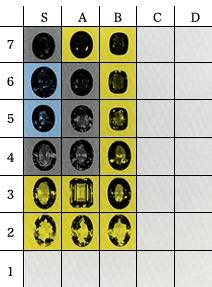

Quantity distribution of gems that are polished to 3-carat size