
A sharp, vertical line of silver appears when light strikes this gem's surface, making it sparkle like its namesake.
The name "cat's-eye" ordinarily refers to cat's-eye chrysoberyl. This gemstone is named after the cat's-eye appearance of the single sharp, vertical line displayed when light is reflected off its surface. The ancient Romans were familiar with cat's-eye chrysoberyl by the first century, and in the East it was believed that pressing a cat's-eye on the forehead between the eyes would endow a person with clearness of foresight. In Sri Lanka, the original historical source of cat's-eye chrysoberyl, it was believed to offer protection from demons.
The most desirable cat's-eye chrysoberyls show a distinct band of light centered on the cabochon's surface. As the light source moves, this band also moves from left to right, and the coloration on either side of the band changes. Most highly prized are those that show a honey color on the side closer to the light source and a milky translucence on the far side, as shown in the photograph on the n This cat's-eye effect is called "chatoyancy," derived from chat, the French word for "cat." Chatoyancy is caused by numerous parallel, needle-like inclusions within the stone. next page
Light reflected off these inclusions is focused by the cabochon's curved surface, causing the chatoyant band to appear. If the cabochon surface is too high, a sharp band still appears, but it will not move back and forth. A low cabochon surface makes the band wavy and indistinct. On poorly cut stones, the band may be off-center or run diagonally across the stone.
Cat's-eye is a variety of the mineral chrysoberyl, as is alexandrite, which changes color between incandescent and fluorescent lighting. The rare cat's-eye alexandrite exhibits both effects simultaneously.
At the auction houses of Christie's and Sotheby's, men's rings set with cat's-eye chrysoberyls exceeding five carats occasionally come up for sale. Although cat's-eye chrysoberyl is a gemstone favored by men in the United States because of its exceptional durability, in Japan, relatively small cat's-eyes weighing two to three carats are often fashioned into and sold as women's rings.
The current major sources of cat's-eye chrysoberyl are Sri Lanka, Tanzania, Brazil, and India.

Ring, platinum
Cat's-Eye Chrysoberyl 1pc
2.50 ct
Untreated
Diamond 30 pc
Name of mineral : Chrysoberyl
Mohs hardness : 8 1/2
Refractive index : 1.746~1.755
Specific gravity : 3.73

Weight : 21.59 ct
Size (mm) : L 14.8 x W 12.1 x D 11.82
Untreated
Gem Quality
CHATOYANT GEMSTONES
Although "cat's-eye" by itself usually refers to cat's-eye chrysoberyl, there are approximately fifty species of gemstones that may exhibit chatoyancy, including emerald, tourmaline, quartz, apatite, and zircon. If one of these happens to contain needle-like inclusions oriented in a single direction, and is cut as a cabochon, light shined on it will be concentrated and the chatoyancy will appear. The proper way to refer to these gemstones is to prefix their names with the words "cat's-eye".
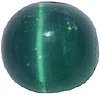
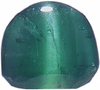
Weight : 1.92 ct
Size (mm) : L 6.5 x W 6.4 x
D 5.73
Cat's-Eye Emerald
There are some fine-quality Cat's-eye emeralds among the emeralds from Brazil. Those with deep color and well-defined chatoyancy are very expensive, and may command prices in excess of $20,000 for a five-carat stone. Cat's-eye emeralds from Colombia have also begun to appear on the market. The piece shown here is of Brazilian origin.
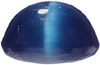
Cat's-Eye Tourmaline
This material is mined in considerable quantities, but it usually does not have the high transparency and well-defined chatoyancy required for gem quality. Low-quality material is opaque, but tends to have distinct chatoyancy due to an abundance of inclusions. In an unfortunate tradeoff, the transparency improves as the number of inclusions decreases, but the chatoyancy also becomes weaker and weaker. The most common colors for cat's-eye tourmalines are green and blue.
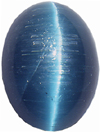
Weight : 4.79 ct
Size (mm) : L 12.1 x W 9.0x
D 5.57 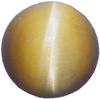
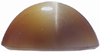
Weight : 10.15 ct
Size (mm) :Diameter 14.8 x D7.04
Tiger's-Eye
Tiger's-eye is a brown variety of quartz that exhibits chatoyancy. Hawk's-eye is a similar variety of chatoyant quartz that is a blue to green color. Tiger's-eye is mined in South Africa in extremely large quantities, and is inexpensive.
JUDGING QUALITY
Key to the quality of a cat's-eye chrysoberyl are (1) the appearance of the chatoyant effect, (2) an optimum color and transparency, and (3) its overall shape and form. It goes without saying that any imperfection large enough to detract from the gemstone’s beauty will lower its quality and diminish its value.
Fine-quality material displays a single sharp line of light precisely in the middle of the cabochon when illuminated directly from above, but under indirect lighting the chatoyant band will be diffused. The chatoyant band will also appear weaker in more transparent stones. Simply put, the band becomes less visible as the number of needle-like inclusions decreases. Even if the cat's-eye is sharp, however, an opaque stone is not considered fine material. Finally, a chatoyant band that extends completely along the vertical direction of the cabochon is most desirable.
The base of a cat's-eye commonly has a rough finish similar to etched glass to enhance the chatoyant effect. There may be remnants of the rough crystal's surface on the bottom, but this is not a problem. In gem-quality material, the bottom of the stone must not be so deep that it would interfere with setting the stone in jewelry.
The ideal color for a cat's-eye chrysoberyl is the "milk-and-honey" color shown in the photograph on the previous page, but most stones show a lemon yellow, greenish yellow, or dark brown color instead of a honey color. Cat's-eyes from the state of Orissa in India are often well-shaped stones with a greenish color, but because production is high, prices are low. The samples shown in 1-C and 1-D of the quality scale are from Orissa, while the remaining spaces show stones from the current major producing countries of Sri Lanka and Brazil.
HOW TO CHOOSE
The ideal choice for a cat's-eye chrysoberyl is one that exhibits distinct chatoyancy and a well-balanced change in its honey-colored and milky portions as it moves, and has a good overall shape and form. In reality, however, such a stone rarely exists. The optimum size for a cat's-eye used as the main stone in a ring is 7 to 8 millimeters (about .25 to .33 inch), and a weight of over two carats. Assuming that a pleasing overall appearance is the absolute minimum requirement, it is realistic to choose a stone with emphasis on either the appearance of the chatoyancy, or the stone's color. When buying loose stones, it is especially important to not select a stone with a base that is too deep. It is difficult to set a deep stone in jewelry, and odds are that such a gemstone would end up not being used at all.
The value of a three-carat-size cat's-eye chrysoberyl of jewelry quality is approximately US $5,000 for the stone alone. (2001)
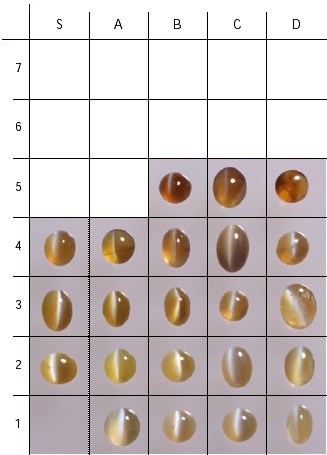
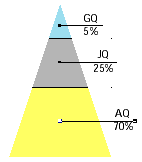
The 3 quality zones as they appear in the quality scale
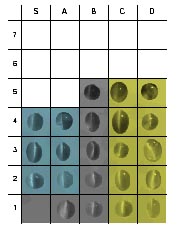
Quantity distribution of gems that are polished to 3-carat size
A GEM OF VALUE
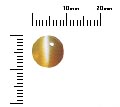
Weight:4.69ct
Size(mm):L9.6 x W9.3 x D5.43
Untreated
Gem Quality