
This gemstone was called "the compass of the Vikings."
With a rich blue color when viewed from above, it appears almost completely colorless from the side.
Iolite's name comes from the Greek words ios, meaning "violet," and lithos, meaning "stone." It is also called "cordierite." When viewed from above, it shows a blue to violet color, while from the side it appears nearly colorless or very light brown. This mysterious property of showing different colors in different directions, called "pleochroism," is especially strong in iolite. Due to an appearance that simultaneously reminds one of the deep blue of sapphire and the transparency of water, iolite was long referred to as "water sapphire." This unique appearance also makes iolite easy to identify at a glance among the many blue gemstones.
In their day, the Vikings of northern Europe apparently used thin slices of iolite as polarizing lenses, allowing them to determine the position of the sun and navigate the seas, regardless of haze, fog, or clouds. Because of this, iolite has also been called "the compass of the Vikings."
When used as jewelry material, only transparent iolites are faceted, while translucent ones are cut as cabochons. Compared to the similarly colored sapphire, it is a far more affordable gemstone. However, iolite has a distinctive, calm blue color that should be enjoyed for its own characteristic beauty, not as a substitute for gem-quality blue sapphire. In addition to cabochons, low-quality material is also used in carvings.
A majority of blue sapphires are heated to bring out their beautiful color, but iolite is a gemstone that is used in its natural state and never heat-treated. With a Mohs hardness of 7 to 71/2, it is harder than quartz and poses no problems with durability. Currently, the major sources of iolite are Sri Lanka, India, Brazil, Tanzania, and Namibia.
Iolite is a relatively unknown gemstone, but its beauty and unique character give it the potential to become a popular gemstone, if sufficient mining production can be maintained in the future.
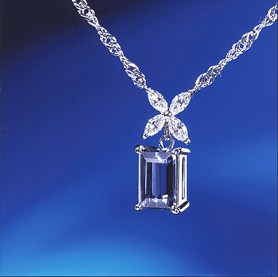
Necklace, Platinum
Iolite 1 pc
Untreated
1.18 ct
Diamond 4 pc
Name of Mineral :Iolite
Mohs Hardness : 7~71/2
Refractive Index : 1.542~1.551
Specific Gravity : 2.61
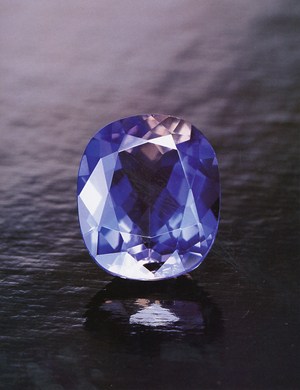
Weight :3.44 ct
Size (mm) : L 11.1 x W 9.2 x D 5.72
Untreated
Gem Quality
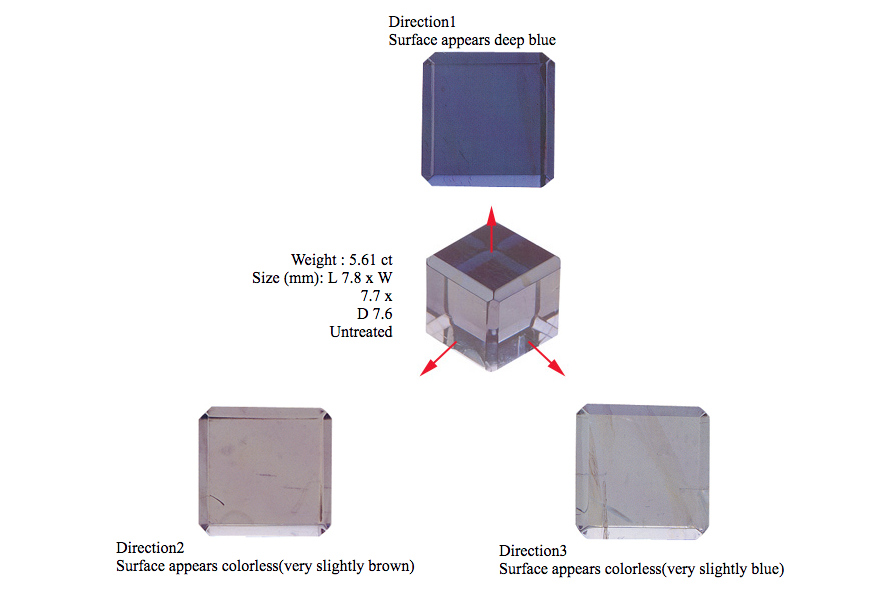
PLEOCHROISM
Gemstones such as ruby or blue sapphire that are doubly refractive (having the ability to split a beam of light entering the gemstone into two rays) may show two or three different colors when viewed from different directions. Iolite is a remarkable example of this. As shown here, a deep blue is seen when viewed from one direction, while a second direction is nearly colorless with a very slight brownish tint, and the third direction also appears nearly colorless, this time with a very slight bluish hue.
A clearly defined separation of colors such as this depends on the orientation of the cut in relation to the crystal, and even a slight difference in angles will have a pronounced effect on the beauty of the gemstone. The characteristic calm beauty of iolite is the result of the crystal's inherent pleochroism combined with an appropriate cut to bring it out. Tanzanite, which has been especially popular in the United States over the past decade, is another gemstone with strong pleochroism.
JUDGING QUALITY
Gem-quality iolite is highly transparent with a beautiful violet-blue color, falling in the range of beauty grades S to A and tone levels 6 to 4 on the quality scale. It is apparent that some of the stones in column D are milky and have low transparency. These are accessory quality, and will usually be cut as cabochons. Such milky cabochons exhibit a soft beauty, and are used in affordable adornments because of their low prices.
HOW TO CHOOSE
When choosing an iolite, look for a highly transparent gem with a beautiful violet-blue color. Since it is basically a low-priced gemstone, it is best to insist on gem quality when looking for a faceted iolite.Because of iolite’s extreme pleochroism, a stone that appears blue face-up will look washed-out when viewed at an angle, changing its appearance drastically. It is necessary to look at the stone from different angles to confirm its appearance. This is a characteristic of iolite, and an awareness of its different appearances adds to its enjoyment.Whether faceted or cabochon-cut, extremely dark iolites with tones of 7 or more should be avoided. A tone of 3 is recommended for qualities other than gem quality.The value of a three-carat-size iolite of jewelry quality is approximately US $200 for the stone alone. (2001)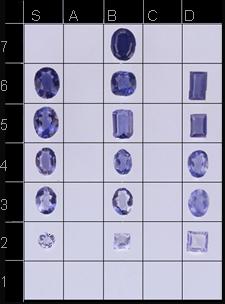
QUALITY SCALE AQUAMARINE Heated
