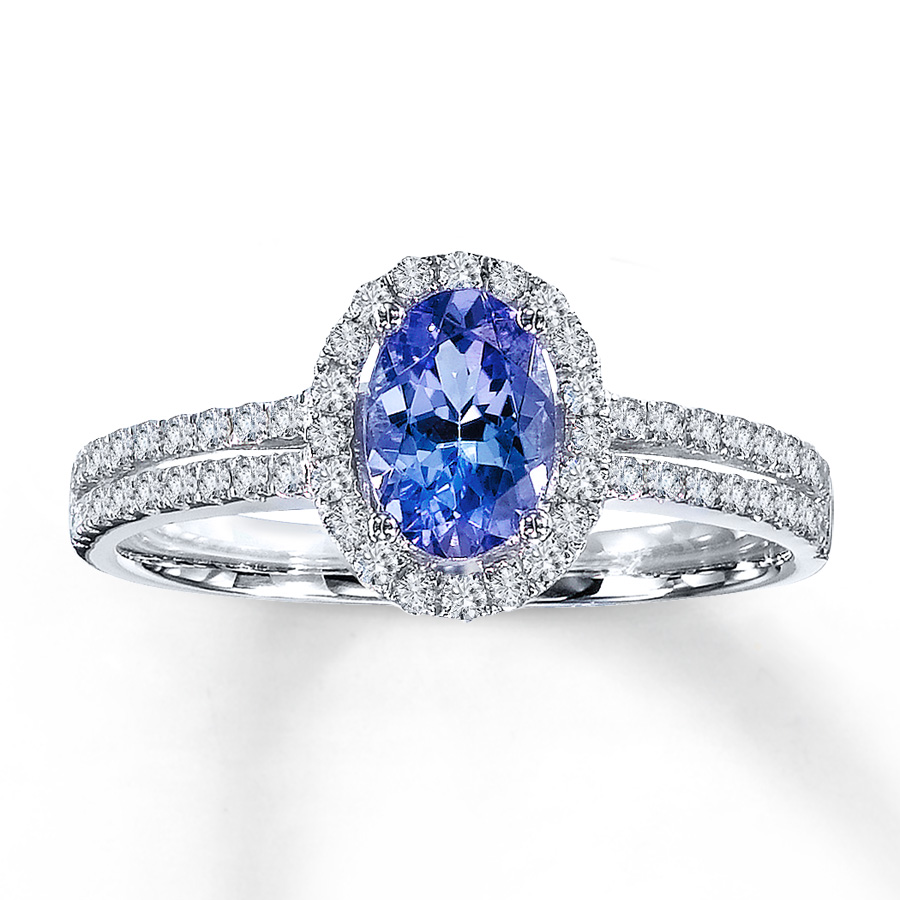
Though its history dates back only thirty years, this highly transparent
blue gemstone possesses a beauty that may surpass even sapphire.
The mining of blue zoisite started in the east African country of Tanzania in the 1960s. In 1967, Mr. Henry B. Platt, then president of Tiffany & Co. of the United States, named this beautiful blue zoisite “tanzanite” in honor of its country of origin, and gradually popularized it through an aggressive sales promotion. With increases in production quality since 1989, prices have become affordable, and today more tanzanite is seen on the world market.
Incidentally, Kenya, also in eastern Africa, has been producing tsavorite (green grossular garnet) since the late 1960s. The region also produces materials such as fancy sapphire, ruby, emerald, and rhodolite garnet. Along with the Afghanistan / Pakistan region and China, eastern Africa is anticipated to become one of the three most important new gemstone-mining areas of the 21st century.
Tanzanite has a very attractive blue color that contains some purple. A distinct purplish hue can be seen in the photograph to the next page. Different from the “royal” blue of sapphire, this blue contains a very slight reddish hue, and could be described as “plum” blue. Tanzanite is a representative example of a stone showing the property of pleochroism. Pleochroism causes different colors to be seen when a stone is viewed from different angles; in the case of tanzanite, blue, purplish red, and light greenish yellow or brown are seen. When viewed face-up, these three colors combine to appear as the typical tanzanite color.
Starting with sapphire, there are many blue gemstones in the market- including fancy blue diamond, indicolite (blue tourmaline), aquamarine, lapis lazuli, and turquoise. Of the blue gemstones that are faceted, extremely beautiful tanzanites with a dark blue color and high transparency can be found relatively easily, with prices markedly lower than those of sapphires with similar beauty.
However, tanzanite has a hardness of 6 to 7, making its durability slightly less than ideal when compared to the hardness standard of 7 for quartz. Because of this, demand relative to production is low compared to that f sapphire.
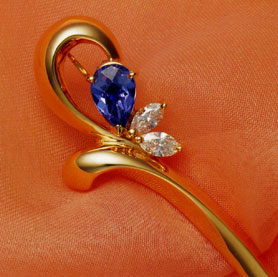
Brooch, Gold
Tanzanite 1pc
0.85 ct
Heated
Diamond 2 pc
0.26 ct
US $1,600
Name of mineral : Zoisite
Mohs hardness : 6~7
Refractive index : 1.691~1.700
Specific gravity : 3.35
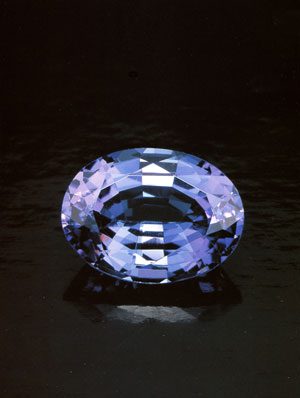
Weight: 4.61 ct
Size (mm) : L 12.0 x W 9.0 x D 5.85
Heated
Gem Quality
US $4,000
VARIETIES OF ZOISITE
East Africa is the current source of tanzanite. Most tanzanite rough is heat treated to remove a yellowish or brownish color and bring out the blue. However, not all tanzanites become the same shade when heated. The differences in each rough crystal’s composition result in different colors, just as in the case of sapphire or aquamarine. Here we will discuss unheated blue and green material, as well as heated blue material.
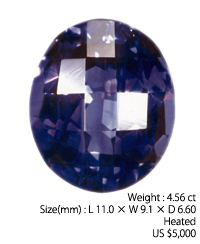
Tanzanite (Heated)
This is a typical heat-treated tanzanite, cut in an unusual style called a checkerboard cut. The term “cut” refers to many different aspects: shape, face-up outline, proportions, finish, and the arrangement of facets, such as this checkerboard style. This stone would accurately be called an “oval-shaped checkerboard-cut” tanzanite.
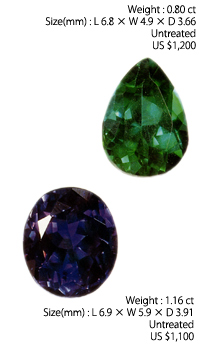
Green Zoisite(Untreated)
The term “green tanzanite” is a misnomer, because tanzanite is a trade name reserved for only the blue gem variety of zoisite. Nomenclature is an important factor influencing the desirability of a product, and while the name “zoisite” may seem a little formal, the word “tanzanite” has enjoyed great success as a trade name due to the aura of mystique that surrounds it. Regardless, the availability of green zoisite is extremely limited and the possibility of it becoming a commercial product appears to be very slim.
Tanzanite (Untreated)
This naturally blue zoisite contains inclusions that are nearly invisible to the unaided eye. At magnification of 10 times, one can barely make out a black fragment near the surface at the edge of the table and reflective fracture directly beneath the table. The blue color and tone of 5 make these even less apparent. Other than surface-reaching fractures, inclusions that are invisible to the unaided eye have little effect on value. This is because while transparency or saturation levels clearly affect beauty, inclusions that cannot be seen without magnification do not lessen the attractiveness of a stone.
JUDGING QUALITY
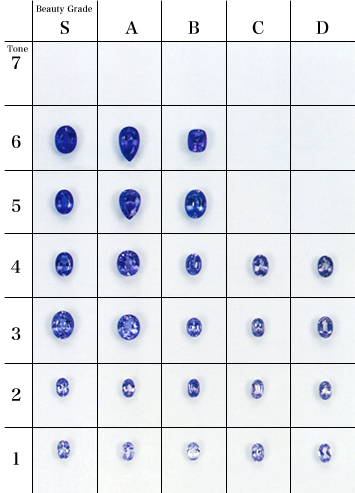
Tanzanites with a deep color and a high level of transparency are considered attractive. In particular, stones with weaker pleochroism that resemble sapphires are given a beauty grade of S. A tanzanite with a sapphire-blue color under indirect sunlight will take on a purplish hue under incandescent light. Stones in which the degree of change is small are considered S, while stones that change distinctly are assigned a beauty grade of A.
In the West, stones with weaker pleochroism are preferred, but in Japan there are cases where the pleochroism is preferred as a characteristic trait of tanzanite. Since tanzanaite is not a substitute for sapphire, perhaps this property should be appreciated as part of the character of the gemstone. Visible pleochroism is determined to a large degree by the angles used at the time of fashioning, and polishing styles will probably settle into those that are considered optimum based in what is in demand. Finally, because tanzanite is a soft gemstone and the finish is often abraded, finish is given special attention when assigning the beauty grade.
QUALITY SCALE
TANZANITE
Heated
HOW TO CHOOSE
Tanzanite is an extremely beautiful blue gemstone. It is not a substitute for sapphire, so there is no need to insist on one that shows little pleochroism. However, stones with excessive pleochroism or a strong purplish color even under natural light should be avoided. Also, because tanzanite is a soft material, it is important that it be worn in jewelry other than rings. Rings can be bumped without one’s noticing, possibly chipping the stone. One should keep these properties in mind when choosing and enjoying tanzanite.
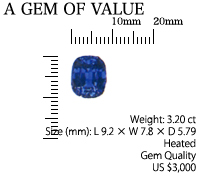
The value of a three-carat-size tanzanite of jewelry quality is approximately US $1,400 for the stone alone (2004)..
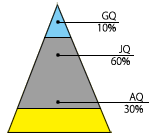
The 3 quality zones as they appear in the quality scale

Quantity distribution of gems that are polished to 3-carat size
| VALUE INDEX | ||||||||||||||||
| ||||||||||||||||
 | ||||||||||||||||
|