The impressive brilliance of a large diamond enriches one's life.
New York is the world’s foremost cutting center for large diamonds, including pear shapes. The reason why there are many pear shapes is that they lose less weight during polishing, and there is the added advantage than a pear shape of seven or eight carats will look as large as a ten-carat round diamond because of its somewhat flat make. However, not all pear shapes meet expectations. Many also reenter the market after repolishing, and unless a cutter specifically mentions that a diamond was newly polished from a particular piece of rough, it is impossible to tell if the stone was recently mined.
Even if a large stone has imperfections (VS or SI grades), the key is to look for one that has no defects, a beautiful outline, and a high level of transparency. Insisting on a diamond that is colorless and free from imperfections (D-IF), but choosing a thickly cut stone with insufficient brilliance and beauty should be avoided by seeking the advice of someone knowledgeable. Even after one has enjoyed its beauty for years and experienced the comfort that it brings, a beautiful large diamond that is free of defects will maintain a high, internationally accepted value as an asset. Fine gemstones enrich the soul and add composure to one’s life, and examples of their putting a positive spin on a situation are far too numerous to mention. A certain age allows one the luxury of wearing large diamonds and other high-priced jewelry.
The diamond cluster earrings shown below contain twenty diamonds-marquises, pears, and rounds-totaling ten carats, in a wire setting. To show off the beautiful brilliance of the diamonds in their leading role, this setting conceals the precious metal holding the gemstones as much as possible. This style, where the piece appears to be constructed only of gemstones, is a trait of jewelry made by Harry Winston, Inc. Harry Winston (1896-1978) will be remembered by many as the foremost “large stone” dealer of 20th century, but he was also a jeweler who poured his passion into bringing out the maximum potential of beautiful gemstones.
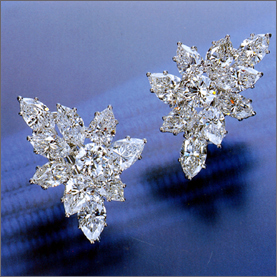
Earrings
Harry Winston
950 Platinum
Diamond
Size (mm):L28 x W20 x H17 each

Large Diamond Ring
Harry Winston
Metal : 950 Platinum
Total Weight : 8.0 grams
Size(mm) : L21 x W16 x H25
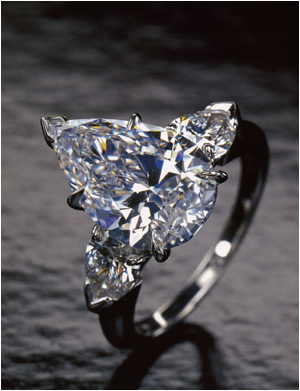
Diamond
Untreated
Gem Quality
Size (mm): L 15.4 x W 9.4 x H 5.88
Weight: 5.06ct
CONVERTING JEWELRY
Not only can convertible jewelry be worn during work of after hours by attaching or removing the colored stone; the fact that a single gemstone can be enjoyed as two different pieces of jewelry, such as a brooch and pendant, is also a strong point. Since the gemstones are repeatedly attached and removed, it is important that the connecting mechanism be both strong and easy to use. Looking at this area from behind, near the top we can see a box and safely that hold the tongue in place. The head slides smoothly into place, and the safety fits securely. The pin is constructed to hold the safety closed, so there is no chance that safety will open while the brooch is being worn, allowing the gemstone to fall. When choosing gemstones, it is also necessary to consider the effects of warm-and cool-colored gemstones and the precious metal in the setting/ for example, platinum looks better with blue gemstones, while yellow gold matches the warm reds and orange colors. However, the point is that this piece allows you to use the gemstones freely and to enjoy switching the heads.
The best thickness of pin for this brooch is one millimeter. A pin of this thickness will have an effect on fabrics, but anything thinner will be unstable and bend easily, making it difficult to deal with. In addition, the pin latch is constructed to hold the pin securely in place when closed. It clicks shut audibly when securing the pin, so there is no chance that the brooch will come off unnoticed..

THE NUMBER AND
STRENGTH OF PRONGS
The fear of prongs becoming loose and causing precious gemstones to fall out is understandable. In response to this insecurity, six-pronged settings are sometimes used instead of four-pronged ones, or the gemstones can be set in prongs that are thicker than necessary. Becoming overly cautious and not allowing the full beauty of a gemstone to show, however, is regrettable.
Placing the upper bezel high as shown in the top photographs to the right will improve the strength of a four-pronged, 950 platinum setting. Opening the prongs in such a setting would require the application of quite a bit of force. For a larger stone, however, there would also be the option of making the setting a bit thinner, with six prongs.
In the case of four ling, slim prongs without an upper bezel, a strong force against one of the prongs may bend it open and allow the stone to fall out. The same situation in a six-pronged setting will not result in the stone falling out. The ring shown at the bottom is a 14K gold solitaire ring, a common style in the United States. The thin prongs on this ring are made hard to resist bending.
If the same style were made with a platinum/Palladium alloy, one can imagine how the stone would fall out of the setting time and time again. Since the hardness of each type of precious metal is different, the styles used for each one are also different.
