With a history of less than 100 years, black opal’s greatest appeal
lies in the fact that each one possesses a totally unique beauty.
As long ago as ancient Roman times, light opal was found in high qualities in northern Hungary. In contrast, black opal was only discovered in 1902, at Lightning Ridge in the Australian state of New South Wales. This was as short time after light opal was first mined in Australia’s Queensland and New South Wales; combined with the discovery of black opal, Australian production soon surpassed that of Hungary.
The highest qualities of black opal exhibit a vividly brilliant play-of-color across the entire stone, while dull stores with areas that do not show play-of-color are considered low quality. Also, as the viewing angle of a black opal is changed, different play-of-color appears. The cause of this play-of-color can be explained in scientific terms, but the fact that it is created by nature is miraculous. Although the mineral opal is distributed widely near the earth’s surface, it is only by chance that nature has bestowed upon is gem-quality opal, creating it against odds of billions to one. On top of this, black opal’s characteristic of displaying a completely different color pattern depending on the viewing angle results in a marvelous beauty that is not seen in any other gemstone.
Compared to light opal, black opal contains less water and is less susceptible to crazing, but its hardness of 5 to 6 1/2, which makes it easy to scratch, and its poor toughness male it important to take care while wearing this stone. Black opal is especially popular with the Japanese; it has been estimated that until recently, more than half of world production was imported by Japan.
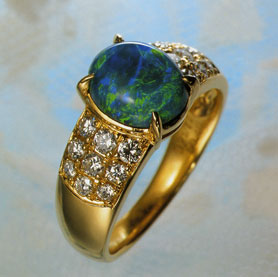
Ring, Gold
Black Opal 1 pc
1.71 ct
Untreated
Diamond 18 pc
0.40 ct

Name of mineral : Opal
Mohs hardness : 5~ 6
Refractive index : 1.450
Specific gravity : 2.15
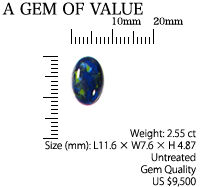
Weight: 2.78 ct
Size (mm) : L 13.3 x W 8.8 x D 3.61
Untreated
Gem Quality
US $14,000
TYPE OF COLORS
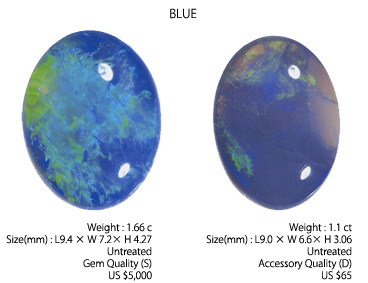
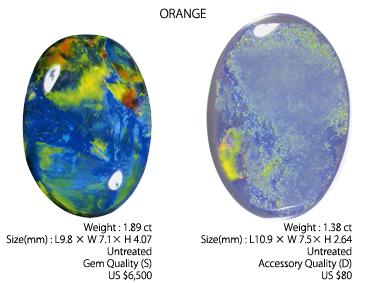
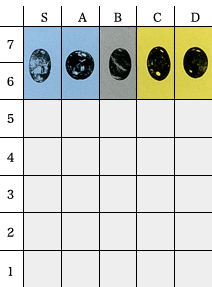
In terms of quality, it is debatable as to which hue in the play-of-color is most valuable. It is said that red is most preferred, followed in order by orange, green, and blue, but it is also important that the stone be brilliant, of course, and that the colors be clear and vivid. Given equal conditions, red is considered the best hue. However, even the exact shade of red- an orangey, a pure red, or a purplish red- is seen as important, and since there are differences even within these hues, the final decision must be based on how attractive the color appears. Here we have compared grades S and D in red, orange, and blue. In D qualities, the color is dull and unattractive, making it irrelevant whether or not a red color appears. This is a common point in the evaluation of any type of gemstone. For example, it is futile to argue the rarity of color or lack of inclusions in a diamond that lacks brilliance.

JUDGING QUALITY
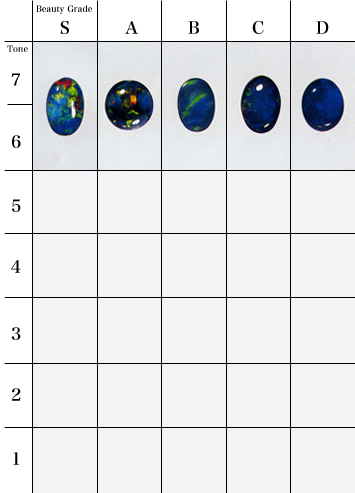
As with light opal, the basis for evaluating the fineness of a black opal is the combination of brilliance and color. Strong colors and an overall brightness are absolute requirements for a high-quality black opal. Among stones with good appearance and shape, sufficient thickness, and absence of cracks (crazing), premium prices are given to those with strong play-of-color of red, orange, green, and blue, in that order. Furthermore, the shape of the pattern is important, with patterns of large mosaic patches considered more desirable than small pinpoint patterns. Of these, the more attractive patterns have specific names and are highly valued. Some black opals show totally different directions, such as yellow and green from one direction and red from another, or blue from one direction and green from another, and these are further valued for their rarity. Black opals have tones around 6 or 7, and the beauty grade is assigned using the brightness of color as a basis, taking into consideration such factors as appearance, shape, and the presence of cracks.
QUALITY SCALE
BLACK OPALS
Untreated
HOW TO CHOOSE
Black opals are polished to minimize weight loss while showing as beautiful a surface as possible. Consequently, each piece is unique in its shape and in the way it exhibits color, making each one-of-a-kind. It is wise to choose a gem- or jewelry-quality stone of 1 to 3 carats.
When considering production costs and the quality of design, it is probably best to purchase a finished ring or earrings at a reputable store. A loose black opal can be purchased overseas and brought home, but opals have low hardness and contain water, so remember that accidents may occur during manufacturing.
The value of a three- carat-size black opal of jewelry quality is approximately US $3,000 for the stone alone (2004).
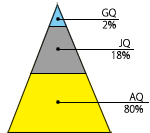
The 3 quality zones as they appear in the quality scale
Quantity distribution of gems that are polished to 3-carat size
| VALUE INDEX | ||||||||||||||||
| ||||||||||||||||
 | ||||||||||||||||
|