
The Buddhists believed that lapis lazuli dissolved ill will and allowed one to act with presence of mind.
Adoring oneself with this gem is said to make a person sincere and trustworthy.
In Latin, “lapis lazuli” means “blue stone.” However, the name “lapis lazuli” was not used until the Middle Age, and the ancient Greeks and Romans called this blue stone “sapphire.” In Egypt, beads, scarabs, pendants, and inlaid jewelry of lapis lazuli were used from about 3100 B.C. Lapis lazuli comes from the Badakhshan district in northeastern Afghanistan, and it was apparently transported over a great distance to reach the market in Egypt, where it was an esteemed gemstone and talisman and was also used in powdered from as a medicine and cosmetic.
The Buddhists attributed to lapis lazuli the power to preserve presence of mind while driving out malicious intentions. It is probably due to this that in China during the time of Confucius, around the sixth to fifth centuries B.C., lapis lazuli was made into hair ornaments and belt adornments. From Afghanistan in central Asia, lapis lazuli was carried both east and west, traveling along the Silk Road through China and even to Japan. Centuries-old personal adornments made from lapis lazuli are stored at the Shosoin Temple in Nara, Japan. Since ancient times, the Japanese favored lapis lazuli along with coral, and many of their literary works make mention of this stone.
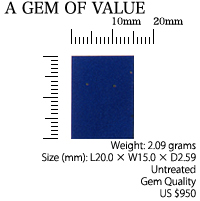
Much like turquoise, jadeite, and opal, rough lapis lazuli occurs as a mass of rock. Of this, only a limited portion is cut into attractive gemstones with good color. In my experience, only about one in 1,000 stones are as beautiful as the one in the photograph to the next page. Because many pieces of lapis lazuli are dyed, caution is advised. It is easy to detect the presence of dye, however, since the color of natural material will not come off when wiped with cotton dipped in acetone.
Lapis lazuli is used in carious ways, such as in watch faces, cameos, and ornaments. With a harness of 5 1/2, lapis lazuli can be scratched by quartz (hardness 7 ), but it exhibits relatively good toughness and will rarely chip.
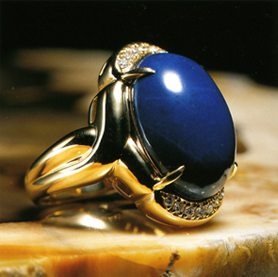
Ring, Gold
Lapis Lazuli 1pc
2.46 grams
Untreated
Diamond 14 pc
0.14 ct
US $1,300
Name of mineral : A rock composed primarily of lazurite, calcite, ajd pyrite.
Mohs hardness : 5 ~ 6
Refractive index : 1.50~1.67
Specific gravity : 2.75
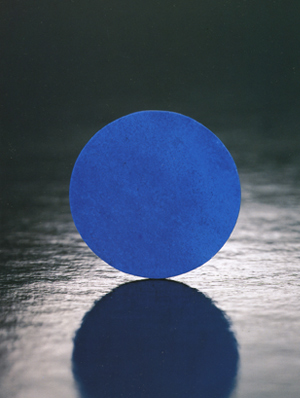
Weight: 1.26 grams
Size (mm) : Diameter 20.2 x H 8.00
Untreated
Gem Quality
CUTTING STYLES
Afghanistan is the main source of lapis lazuli, in terms of both quality and quantity. During the civil war of 1984, the Afghanistan government sold large quantities of lapis lazuli hit the Western markets, softening prices. Other sources of lapis lazuli are the Lake Baikal area in Siberia, Chile, and the United States.
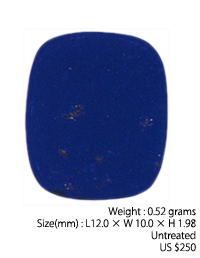
Tablets
Lapis lazuli is cut into flat tablets, something seldom seen in turquoise, jadeite, or opal. Maximum beauty is achieved when this gemstone is fashioned into tablets, and many of these can be seen in men’s rings and cuff links. Taking into consideration the toughness of the material, polishing factories set the minimum thickness standard at 2.5 millimeters (0.10 inch). If cut any thinner than this, problems with durability arise, and it becomes difficult to cover the weight loss with the price.
CABOCHONS
Many stones are seen fashioned as cabochons for use in rings and earrings. However, this cut is not used for material of exceptional quality. The finest lapis lazuli is fashioned into tablets or superb carvings, while the rough that is most often used for cabochons is of jewelry or accessory quality. Lapis lazuli is widely used in accessories.
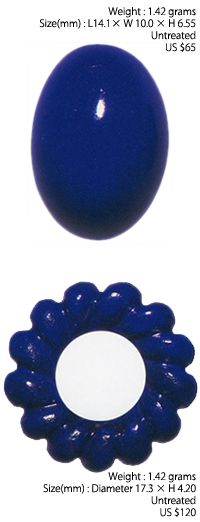
Carvings
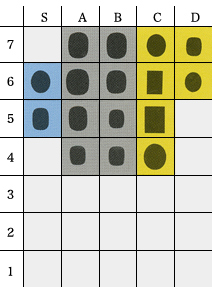
Ornaments and small articles carved from lapis lazuli are judged based on the quality of material and skill of workmanship. The degree of fineness of material can be determined by simply matching it to the squares in the chart to the next page. Instead of observing tone and beauty grade simultaneously, first determine the tone, and then judge the beauty grade to make a fairly accurate decision.
JUDGING QUALITY
When judging the quality of lapis lazuli tablets, one must first confirm whether or not the color is natural. Because dyeing will greatly affect value, it is extremely important to determine whether dye is present and to what extent. Manufacturers will test stones with acetone at the time of purchase. Continuously dealing with a trustworthy supplier is a basic guideline for procuring merchandise of consistent quality.
Second, check for a beautiful azure blue that is evenly distributed throughout the stone. Generally, a greenish cast will lower the beauty grade, while stones will a rich purplish blue color are considered most attractive. Setting aside material that is too light in tone, stones with medium darkness (tone 5) tent to be most desirable
Third, consider the presence of eye-visible inclusions of golden pyrite and white calcite. In this book, the finest stones are considered to be those of gem qualities with a solid azure blue, but stones with a well-balanced distribution of pyrite can be graded to reflect the presence of many buyers. Calcite detracts from beauty, and material that contains it is always assigned low beauty grade.
QUALITY SCALE
LAPIS LAZULIS
Untreated
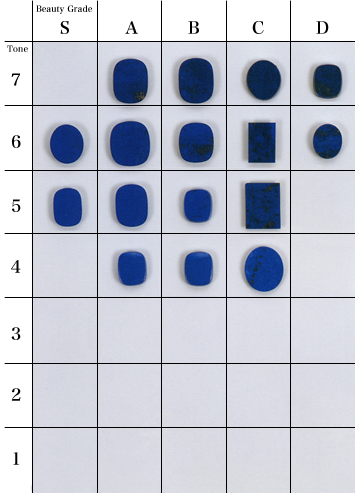
The 3 quality zones as they appear in the quality scale
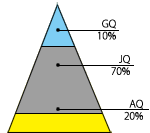
Quantity distribution of gems that are polished to 2-gram size
| VALUE INDEX | ||||||||||||||||
| ||||||||||||||||
 | ||||||||||||||||
|