
In Europe, it was said that this gem made the wearer more eloquent.
Perhaps we could take note of this in modern society.
The mineral olivine sometimes occurs as a gemstone of an olive color, a green mixed with yellow and brown. The more precious of these stones are called peridot. The historical source of this stone is the barren island of Zabargad, located in the Egyptian Red Sea. In the gemstone exhibitions of the Green Vaults in Dresden, Germany, swords and staves set with large peridots are displayed alongside diamonds, sapphires, rubies, and emeralds. Similar-colored gemstones were often confused with each other long ago, and peridot was sometimes mistaken for emerald simply because they are both green.
Peridot has a major characteristic seldom seen in other gemstones. Due to its high birefringence, when viewed through the table, facet junctions on the opposite side are clearly doubled. Of course, this characteristic is more noticeable deeper stones. Ruby, sapphire, and emerald are also doubly refractive gemstones, but this effect cannot be seen with the unaided eye as clearly as it is in peridot.
Peridot became popular in Europe and the United States in the 19th century, but it has not received much attention since then. However, as one of the few attractive green gemstones that is often faceted and can be enjoyed at an affordable price, it is highly likely that it will once again take its place in the limelight. It is also the birthstone for August. Its hardness is 6 1/2 to 7, sufficient for a gemstone. Reflections and refraction cause a mosaic-like pattern consisting of a variety of lovely yellows and greens ranging from olive-yellow to lime-green, which characterize the beauty of peridot. The mosaic patterns seen in the peridot in the photograph to the next page are very well balanced.
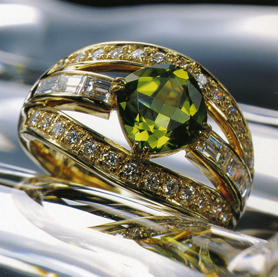
Ring, Gold
Peridot 1 pc
1.76 ct
Untreated
Diamond 32 pc
0.87 ct
US $4,500
Name of mineral : Olivine
Mohs hardness : 6~ 7
Refractive index : 1.654~1.690
Specific gravity : 3.34
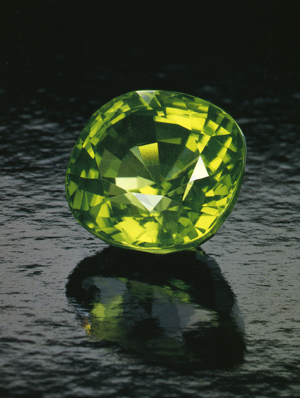
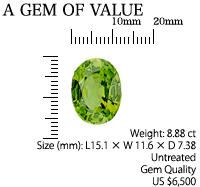
Weight: 18.72 ct
Size (mm) : L 16.4 x W 14.7 x D 10.32
Untreated
Gem Quality
US $14,000
CHARACTEROSTOCS BY COUNTRY OF ORIGIN
The historical source of Zabargad produces very little peridot now; current producers include Arizona in the United States, Myanmar, and Norway, as well as Brazil, China, and Kenya. As the photographs show, peridot from each source has its own characteristic hue. Like emerald, it may be that peridot requires a separate quality scale for each source. However, since it is not a very rare gem, here they are combined into one scale.
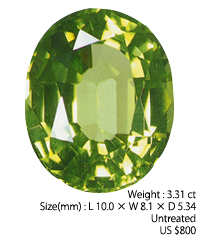
Myanmar (formerly Burma)
Burmese peridot comes from near Mogok, a famous source of ruby. Large material of over 10 carats is recovered there. As the photograph shows, material from Myanmar has an attractive, slightly olive-colored green with little brownness. This stone has been recut to improve its proportions and finish, showing an attractive mosaic-like pattern created by the various tones of color.
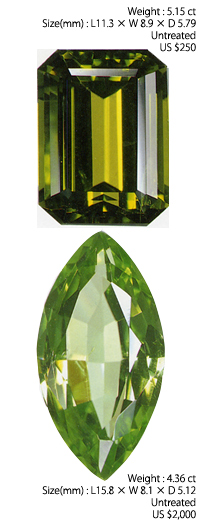
Arizona (United States)
Arizona produces very large quantities, but most of these stones have a brownish or blackish color and are less than 5 carats, so they are used as inexpensive accessories. However, some attractive green stones may be found, and it cannot be said that all are of low quality. Please note the difference in the hues between the Arizona, Myanmar, and Norway material. Rarity differs noticeably between sources, especially in gem qualities, influencing value and price.
Norway
Peridot from sondmore, Norway, is a light but pure green. Peridot from Myanmar cannot compare with this material. One can see how greatly purity and saturation of color, and especially transparency, influence the beauty of a gemstone, much more so that tone. Also, it is important for color to be distributed in abundance throughout the stone instead of in patches, and for the stone to have a good shape and appearance.
JUDGING QUALITY
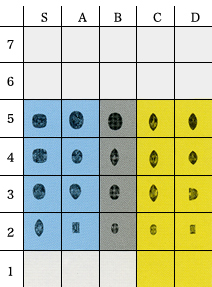
When the quality scale is applied to peridot from various sources, we see material from Myanmar falling in grades S and A, and Arizona material in grade C. Also, Arizona yields few stones larger than 5 carats, while Myanmar produces large stones. Large Burmese stones are often poorly cut, with imperfections, but many of these can be recut into attractive S-quality stones.
The key in judging the quality of peridot is the degree of brownness in the color and the degree of imperfections in the stone. These will decide the beauty grade.
QUALITY SCALE PERIDOTS
Untreated

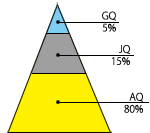
The 3 quality zones as they appear in the quality scale
Quantity distribution of gems that are polished to 3-carat size
| VALUE INDEX | ||||||||||||||||
| ||||||||||||||||
 | ||||||||||||||||
|