
It is said that adorning oneself with the magnificent brilliance of this gift of nature makes the heart pure and tranquil.
The word “diamond” comes from the Greek adamas, meaning “unconquerable”- an appropriate name for the hardest material occurring in nature. Until diamond was discovered in Brazil in 1725, its only source was India, where diamonds were already highly esteemed as talismans by the year 800 B.C. It is believed that diamonds found their way to Europe through the Persian invasion of India. By the 15th century, European women of royalty were wearing diamonds.
In India, cutting initially involved merely removing just the flawed portions of the rough stones, keeping the weight loss of the rough to a minimum. The use of diamond powder led to the development of new polishing techniques that became the origins of modern-day polishing. In the mid-17th century, following the rose cut and other improvements, the Mazarin cut was developed. This was the forerunner of the modern brilliant cut. Although the modern brilliant cut may result in a loss of 50 percent or more from the rough, it is crucial in bringing out the spectacular brilliance of a diamond.
The beauty of the diamond in the photograph to the next is the result of an optimum balance of rainbow-colored dispersion, scintillation, and strong brilliance. Under sunlight or bright lighting, a diamond emits the red, yellow, green, and blue dispersion seen in a prism. As the diamond is moved, the mosaic patterns created by the cut sparkle with breathtaking scintillation. The balance of dispersion, brilliance, and scintillation changes subtly depending on the angles chosen by the cutter. Increasing the colorful dispersion sacrifices brilliance, and maximizing both is not possible. Each rough diamond, created by the powers of nature with its own individual character, is given yet another dimension of individuality through human technology.

Ring, Platinum
Round Brilliant Diamond 1 pc
5.05 ct
Untreated
Diamond 2 pc
0.69 ct
US $180,000
Name of mineral : Diamond
Mohs hardness : 10
Refractive index : 2.417
Specific gravity : 3.52
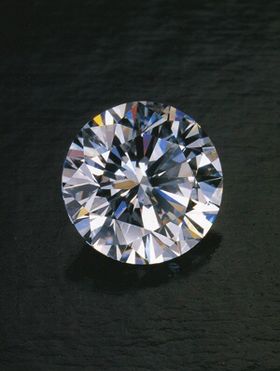

Name of mineral : Diamond
Mohs hardness : 10
Refractive index : 2.417
Specific gravity : 3.52
Weight: 5.25 ct
Size (mm) : Diameter 11.2 x D 6.79
Untreated
Gem Quality
US $250,000
ROUGH STONES AND CUT
Rough diamonds vary greatly in shape, color, and quality. Leaving industrial quantities aside, we have divided gem-quality diamonds into three board categories. It can be seen that the quality of the rough material is a key factor in determining the beautiful brilliance of a polished diamond. The quality of cut will determine the relative merit of stones cut from similar-quality rough, but it is important to note that beautiful brilliance cannot be attained from poor-quality rough, even if it is cut superbly.
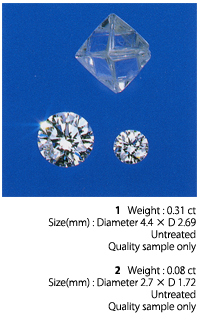
Sawable
Sawable rough diamonds occur as octahedral, which resemble two pyramids attached at the base. This type of rough is mined in quantity in Russia and Namibia, and is so named because it can be effectively sawn and fashioned. Cut with a blade impregnated with diamond powder, such rough is usually polished into two diamonds, one large and one small. Only 10 to 20 percent of all gem-quality rough diamonds are sawable, but these pose relatively few problems during cutting. Because of its regular shape, this type of rough can be polished efficiently, and regardless of size it can be considered quite valuable.

Makable
Makable rough varies considerably in shape from stone to stone, each being polished to accommodate its shape. Makable rough is medium-quality material, but some may polish up to fine qualities despite their poor shape. On the other hand, low qualities that lack beauty may also result. Most small makable rough is currently polished in India.
Near-Gem
Near-gem rough is essentially industrial-quality material that approaches gem quality. Most of this material lacks transparency, containing large dark inclusions as well as numerous fractures. Diamonds polished from this rough also lack transparency, and are used in low-cost jewelry because of their substandard beauty. Care must be taken to detect treatments, such as the drilling of holes in the diamond with lasers to bleach and hide dark inclusions, or the concealment of surface-reaching fractures by impregnation with a substance that males them difficult to see. The presence of treatments may result in large differences in price.
JUDGING QUALITY
The quality of diamonds is judged by examining three factors-beauty, the presence and degree of defects, and size.
A diamond’s “beautiful brilliance” depends on the quality of the rough material and the cut of the stone. For a diamond to exhibit a fine brilliance, it is absolutely necessary for the rough material to have high transparency, no grayish or brownish color, no fluorescence, and no graining (twisted lines in the stone caused by distortion during crystal growth). When material such as this is given a superior cut, the result is a beautifully brilliant diamond of beauty grade S. Diamonds with a beauty grade of B have diminished brilliance, while those with a D grade are translucent and lack beauty. Ascertaining the degree of attractiveness of the brilliance is the main step in judging quality.
The next important step is to determine if there are any distracting dark inclusions or any cleavage that may gave an effect on the diamond’s durability. While not an issue for diamonds with clarity grades if IF or VVS, judging VS and SI diamonds requires confirmation of the nature and location of their inclusions. Diamonds with clarity grades from I1, to I3 contain eye-visible inclusions that affect their beauty.
By itself, a round-brilliant-cut diamond with a diameter of 3 millimeters (0.10 ct) or less will show weak brilliance, while those of 6 millimeters (0.7 ct) or more achieve an impressive brilliance.
A race and valuable diamond is one that is large, free of defects, and beautifully brilliant.
HOW TO CHOOSE
When choosing a diamond that will be enjoyed for generations to come, gem quality is recommended. G color and SI1 or better clarity is recommended.
Stones of accessory quality have insufficient beauty as diamonds, and cannot be wholeheartedly recommended. Once you understand the difference between the beauty of these stones and stones of gem- and jewelry-qualities, you will fine yourself not wearing accessory-quality stones.
The value of a one-carat-size diamond of jewelry quality is approximately US$8,000 for the stone alone. (2004)
QUALITY SCALE
ALEXANDRITES
Untreated

The 3 quality zones as they appear in the quality scale
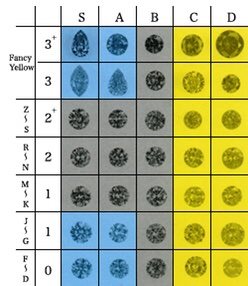
Quantity distribution of gems that are polished to 1-carat size

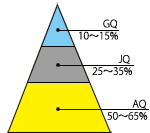

Value Index
| CT Size | Gem Quality | Jewelry Quality | Accessory Quality |
| 10 | 10.0 | 5.0 | 2.0 |
| 3 | 1.8 | 1.0 | 0.4 |
| 0.5 | 0.8 | 0.4 | 0.2 |
