These rubies popularity has risen since 1993, after methods to bring out their color were discovered. Their brilliance is especially beautiful under incandescent lighting.
Since 1993, after establishing themselves competitively, rubies from Mong Hsu in Myanmar have replaced Thai rubies as the market leader. The Mong Hsu region is located east of the central Myanmar city of Mandalay. North of Mandalay is Mogok, an area with a long tradition of ruby mining. Ruby rough from Mong Hsu is taken to Thailand and polished in Chanthaburi.
Although ruby had been mined in Mong Hsu since the mid-1980s, the material was brownish and could not be used as such. In time, methods of high-temperature heat treatment suited to these crystals were discovered, and material rivaling the rubies from Mogok began to appear.
Mong Hsu ruby rough contains more imperfections than Thai material, and the chemicals used during heat treatment may penetrate cracks in the material, remaining there in a glass-like form. Such flawed material may initially seem reasonably priced, but its value is low. Few Mong Hsu rubies are notably large or small, with most polished stones apparently falling in the range of 0.3 to 0.5 carat.
The six Mong Hsu rubies shown in the photograph on the next page are typical shapes seen in the 0.5- to 1.0-carat range. Ovals are by far the most common shape seen in today's market, and they are often used as the main gemstones in rings. These six rubies were chosen for their attractive face-up outlines. With ovals, pear shapes, and heart shapes, the attractiveness of the rounding of the shoulders (corners) is key to beauty. Whether one likes a nearly round heart shape or an elongated heart shape is a matter of personal preference. However, very slight variations in the lines that define the actual heart shape can make the difference between a graceful stone and a boring one. The quality of a gemstone's overall appearance cannot be expressed by numerical values, yet it is critical when judging beauty.
Shortly before ruby mining began in Mong Hsu, rubies from Vietnam had appeared on the market. Yet because of a combination of negative factors such as an influx of synthetic stones, government regulations, and limited mining quantities, Vietnamese rubies are rarely seen today in the trading centers of Thailand. The influx of synthetic stones was not merely a problem for the parties involved, but brought about a general loss in confidence in Vietnamese rubies, preventing that industry from developing.

Ring, Gold
Mong Hsu Ruby 3 pc
0.87 ct
Heated
Diamond 2 pc
US $6,000
Name of Mineral :Corundum
Mohs Hardness : 9
Refractive Index : 1.762~1.770
Specific Gravity :4.00

Mong Hsu, Heated
Gem Quality
us $15,000 (Total)
DIFFERENCES IN APPEARANCE DUE TO SOURCE AND INTENSITY OF LIGHT
The appearance of a gemstone's color changes drastically under different sources and intensities of light. Many of us have had the experience of having a dark blue suit or handbag appear black indoors, only to realize its true color when outside under sunlight. With gemstones, the difference is even more pronounced. The appearance of a gemstone's color will change depending upon the strength of the light entering the stone, as well as the type of light.
Compared to its appearance under north light (natural light entering a room through a north-facing window) at noon on a sunny day, a ruby's quality will seem to diminish by more than half when viewed in the evening or on a rainy day. Rather than simply appearing darker in color, the gemstone will appear to have lost its beauty altogether. Professional gem dealers make quality judgments by comparing gems to "master" stones (reference stones) that serve as a standard, allowing them to judge quality without error even when conditions change. However, judgments made by inexperienced dealers or others who rely on gut feeling are questionable. Reputable gemstone dealers around the world - whether in New York, Geneva, or Tokyo - will always establish quality through comparison with master stones or company inventory.
The beauty of rubies is most apparent when seen under incandescent light, just as dishes laid out on the dining table look more appetizing under incandescent light. Under fluorescent light, both rubies and food lose their appeal, and their beauty is halved. Gems with reddish and orangey colors appear to lose their beauty under fluorescent lighting, making it difficult to compare their qualities.
Conversely, bluish gemstones such as sapphire and aquamarine look more attractive under fluorescent lighting than under incandescent light. It is easier to compare the quality of such gemstones under fluorescent lighting, as even slight differences can be perceived clearly.
As shown in these photographs, the same rubies will appear to have different colors depending upon the light source, such as (1) north light on a sunny day, (2) sunlight on a rainy day, (3) incandescent light, and (4) fluorescent light. When confirming the color of a gemstone indoors, it is best to do so using a combination of incandescent and fluorescent lighting.
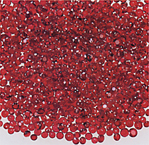
1.North light on a sunny day 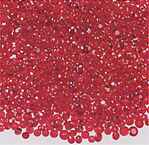
2. Sunlight on a rainy day
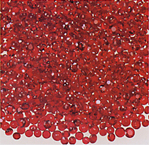
3.Under incandescent light
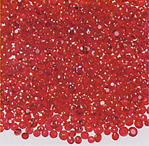
4.Under fluorescent light
Size (mm):Diameter3-4
Mong Hsu Ruby, Heated
Gem Quality
JUDGING QUALITY
The first impression of beauty is very important. A gemstone that gives an impression of beauty just at a glance does so because of a high degree of transparency, a balanced and distinct mosaic pattern throughout the stone, and a fine overall appearance.
There is a tendency for the French to prefer dark rubies (tone levels 7 to 6), while the Italians and Japanese prefer lighter stones (tone levels 5 to 4). In Bangkok, where buyers gather from around the globe, high prices are seen over a wide range of attractive stones, reflecting the variety of tone preferences among nationalities. It is apparent that tone defines the balance between supply and preference-based demand.
Finally, regarding the judging of imperfections, it is important not to be overly concerned with those that are not eye-visible, as long as they are not defects or do not adversely affect durability. However, deciding the acceptable degree of surface imperfections and scratches visible under 10x magnification, as well as other standards of finish quality, is the responsibility of the professional jeweler.

HOW TO CHOOSE
The value of a one-carat-size, heat-treated Mong Hsu ruby of jewelry quality is approximately US $2,000 for the stone alone. (2001)
A GEM OF VALUE
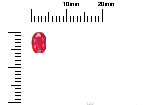
Weight : 0.68 ct
Size (mm) : L 6.1 x W 4.4 x D 2.60
Heated
Gem Quality
US $1,500
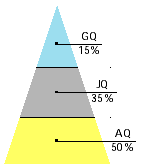
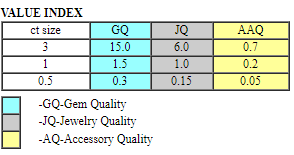
The 3 quality zones as they appear in the quality scale
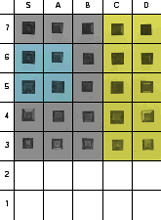
Quantity distribution of gems that are polished to 1-carat size