When the natural crystal is beautiful, it requires no processing beyond polishing.
The brilliance of an untreated Sri Lankan sapphire is in a class of its own.
Traditionally, the most favored color for Sapphire is the rich and soft "cornflower blue" seen in Kashmir stones. Though there is virtually no mining in Kashmir now, sapphires that approach this color are found in Sri Lanka.
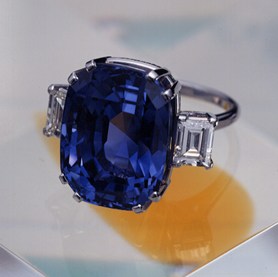
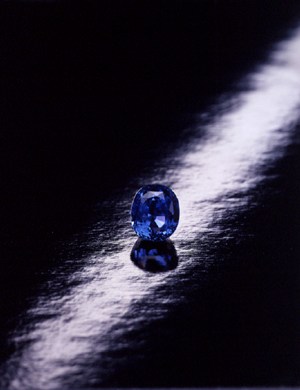
Some of the sapphires that are mined and polished in Sri Lanka are not heated. The photograph on the next page shows an untreated Sri Lankan sapphire. It is transparent with a somewhat velvety appearance, giving it a unique character. A tone level of 5 makes it very attractive even under weak lighting. Darker stones with tone levels of 6 or 7 exhibit a unique and rare beauty under stone lighting, but do not appear as beautiful under weak light. The sapphire in the ring below is also untreated. It has a somewhat light tone of 4, but shines beautifully even from a distance. As with Sri Lanka, there are sapphires from Myanmar and Kashmir that are not heat-treated.
Crystals that have a beautiful color in their natural state do not require any processing beyond polishing. In general, however, most sapphire crystals are not transparent, or they are too dark or too light. These crystals have their transparency and tone of color adjusted through heating at temperatures ranging from several hundred to nearly two thousand degrees Celsius. Around 1977, it was discovered that the near-colorless Sri Lankan sapphire rough called "geuda," which had been routinely discarded until then, would become a gorgeous blue color when heat-treated. Large quantities of this rough material were taken to Thailand, where they were heated and polished. From there they were introduced to the world market, where they have succeeded in capturing the largest share. Though their beauty achieved widespread recognition, deals of their heat treatment have not reached the general public.
There are subtle difference between the liveliness of a naturally beautiful color and that of a beautiful color brought about through heat treatment. And individual's preference is a personal decision, but one that should be made with the knowledge of whether the beauty is natural or a result of treatment.
Sapphires from Tanzania and Madagascar began appearing on the market in the 1990s, and some of these show a fine quality similar to Sri Lankan sapphire. Most large sapphires, however, are from Sri Lanka.
DISTINGUISHING BETWEEN UNTREATED AND HEATED SAPPHIRE
Lapidaries in Sri Lanka who deal in sapphire can determine whether a stone is untreated or heat-treated by looking at the finished stone's appearance. Differences in the transparency and color result in difference in beauty. Through many years of experience, they can recognize an untreated stone.
Simply speaking, sapphire gets its blue color from the elements titanium and iron. If these elements are present in a pale or colorless stone, heat treatment causes a chemical reaction that brings out a deeper blue color.
The high temperatures used to change the color of corundum often have a large effect on the gemstones' inclusions as important clues in determining if a gemstone has been treated. However, interpreting the meaning of inclusion is difficult even for professionals, and other instrumentation is used to confirm whether a sapphire has been treated or not.
Characteristics of Heated Sapphire
The temperatures used during the heat treatment of corundum are often high enough to melt or otherwise seriously damage inclusions of other minerals such as rutile, apatite, or hematite. Melted crystals like the "snowball" inclusions discussed on here are often seen in heat-treated sapphire and rubies.
Another type of inclusion seen in heated corundum is the disc-like fracture. These are tiny internal fractures that form when an included crystal bursts. The melted crystal may enter the break and solidify, often leaving a fringe (as shown in the center of the photograph to the right). These kinds of inclusions offer us a glimpse of the intense nature of the heat treatment process.
Silk Inclusions
Corundum may contain fine, needle-like crystal inclusions of rutile (titanium oxide). These are commonly called "silk" because of their thread-like appearance. Often occurring in sets of parallel lines that intersect at
60angles as shown in the photograph, silk inclusions range in size from those that are eye-visible, to those that visible with a 10-power loupe, to those that require 30-power magnification under a microscope. Silk inclusions can be seen in about 30 percent of the untreated sapphires from Sri Lanka. They often melt during heat treatment, so the presence of silk suggests that a stone has not been heated.
During treatment, titanium from the silk inclusions may also cause a blue color to appear. If enough silk inclusions are present, an eye-visible band of color will appear in the stone.
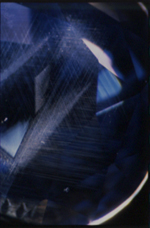
Silk Inclusions
Untreated
Magnification : 63x
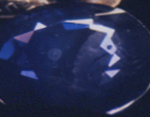
Disk-Like Fracture Inclusions
Heated
Magnification : 20x
JUDGING QUALITY
The first step is to confirm that a sapphire has a beautiful and balanced mosaic pattern when viewed from the table (face-up). A well-balanced mosaic pattern is the basis for determining the beauty of a faceted gemstone, regardless of whether it is untreated or heat-treated, or the tone of its color.
Many stones, especially untreated sapphires from Sri Lanka, are fashioned with an extremely poor make and shape in order to preserve as much of the rough material as possible. There is no need to become anxious about it, but sellers should establish standards for total depth-the ratio of the depth of the stone to its width-to be within a certain range (for example, 50 to 80 percent). Such standards will serve as a basis for making buyers feel more comfortable. It is also important not to be critical of imperfections to the point where one would pass up a beautiful and appealing stone. Other than large inclusions or color patches that are obvious to the unaided eye, imperfections that do not strongly affect beauty are best viewed as minor details. The presence of fine silk inclusions, with their characteristic thread-like appearance, is proof of natural origin, and, if they are intact, an indication of non-treatment. As long as these silk inclusions do not adversely affect a gem's beauty, they can even be thought of as a positive presence.
QUALITY SCALE
UNTREATED SRI LANKAN SAPPHIRES
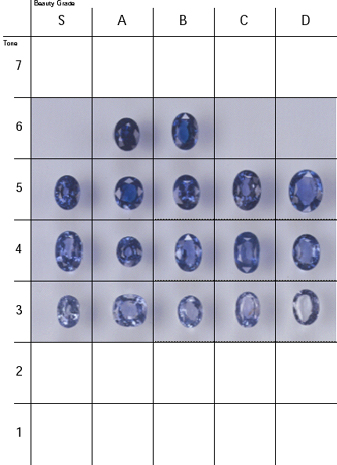
HOW TO CHOOSE
The main point when selecting a sapphire of two or more carats, regardless of its color tone or country of origin, is an attractive mosaic pattern.
For smaller stones, choose one with a lighter color rather than an overly dark stone. For pieces used and worn in jewelry, the stone should be brilliant under various types of lighting.
Large sapphires with a somewhat light color are recommended, as they will be both beautiful and affordable.
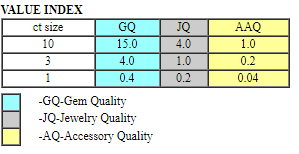
The value of a three-carat-size, untreated Sri Lankan sapphire of jewelry quality is approximately US$4,000 for the stone alone. (2001)
A GEM OF VALUE
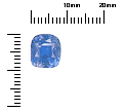
VALUE
Weight:4.80ct
Size(mm):L9.3 x W8.5 x D6.45
Untreated
Jewelry Quality
US $6,000
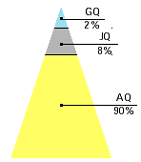
The 3 quality zones as they appear in the quality scale
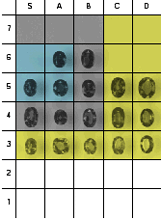
Quantity distribution of gems that are polished to 3-carat size