
Blue gemstones seem to have the power to rouse sincerity,
and wearing a sapphire is said to make a person speak truthfully.
In ancient times, the world “sapphire” was used to refer to all blue stones, and until the Middle Ages “sapphire” referred primarily to lapis lazuli. Since the seventh century B.C., sapphire has been used in jewelry in Greece, Egypt, and Rome, and during the Middle Ages it was a favorite gemstone of many European monarchs. Marco Polo, who visited Sri Lanka in the 13th century, highly praised both sapphire and ruby in his writings.
Sri Lankan rubies are light in color. Though generally lower in value than those from Myanmar (Burma), Sri Lankan sapphires are extremely important. Sapphire and ruby are often mined from the same deposits, but the ration differs greatly from one source to another. In Sri Lanka, sapphires far outnumber rubies.
Sapphire and ruby are the same mineral, corundum, but whereas ruby is colored red by chromium impurities, the blue color in sapphire is caused by iron and titanium impurities. Corundum of any color other than red is called sapphire, but the word “sapphire” by itself usually refers to blue mineral, with stones of other colors called “fancy-colored sapphires.” Fancy-colored sapphires occur in colors such as yellow, green, and orange, to name a few. The different colors are caused by various chemical impurities or differences in crystal structure. Sri Lankan sapphires are often heat treated in Thailand to enhance their blue color, resulting in a characteristic very slightly purplish blue.
As seen in the photograph to the next page, it is a beautiful material with a high level of transparency that is unequaled by sapphires from any other source. The color in Sri Lankan sapphire is not distributed evenly, often being concentrated in different areas of the stone. In extreme cases, material may have just a small area of blue near the culet ( the bottom of a faceted stone), yet show an exceptionally beautiful color when viewed face-up. Although a beautiful face-up color is important, if the colored areas are polished away when such a stone is recut, the result will be a colorless sapphire. Therefore, a cutter must pay careful attention to the location and nature of color conceptions, and orient the stone accordingly when polishing.

Ring, Gold
Sri Lankan Sapphire 1pc
1.64 ct
Heated
Diamond 4 pc
0.97 ct
US $12,000
Name of mineral : Corundum
Mohs hardness : 9
Refractive index : 1.762~1.770
Specific gravity : 4.00
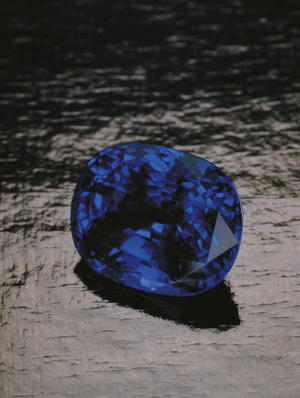
Weight: 9.64 ct
Size (mm) : L 13.5 x W 10.9 x D 7.41
Untreated
Gem Quality
US $120,000
BEAUTY GRADE: ELEMENTS AND JUDGMENT
Using sapphire as an example, let us explain the elements of the beauty grade for gemstones as a whole. The beauty grade ranks the degree of beauty based on a combination of the following eight elements. The beauty grade may be lowered by any one element or by the combined influence of a number of elements.
The sapphire shown immediately below is an attractive gemstone with no major imperfections that detract from its beauty.
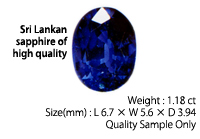
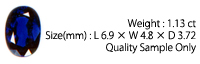
1. Hue
This sapphire’s color is somewhat reddish compared to the one above. While the hue in this particular stone is shifted toward blue-purple, color in sapphire may also shift in the opposite direction and become slightly greenish. Hue may be a characteristic of the country of origin, or it may be related to tone. It is a key point when judging.
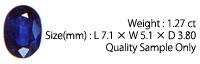
2. Transparency (Nature of Rough)
Compared to the one above, this sapphire has a low transparency level and is somewhat cloudy. Even if other conditions are basically the same, transparency can greatly affect the beauty of a gemstone as well as its value. This applies to diamonds as well as colored stones.
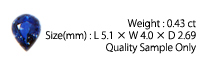
3. Saturation (Purity of Color, Grayness, Brownness)
This sapphire is a very grayish blue. Such grayish color (or brownish color in red to orange gemstones) is not uncommon. Stones with a pure color are said to have high saturation, and those with a strong grayish or brownish color, to have low saturation.
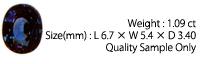
4. Degree and Direction of Pleochroism (Doubly Refractive Minerals Only)
This sapphire shows purplish and green hues besides the blue. This is influenced by the quality of the rough, as well as the position of the table relative to the optic axis of the stone. Pleochroism detracts from the beauty of a stone.
5. Appearance and Shape (Outline, Finish, Profile, and Proportion)
This sapphire is very thin and flat, and its color is almost completely washed out. The beauty of the mosaic-like pattern of facets is absent, and a blue color is visible only around the edge of the stone. This stone does not even qualify as accessory quality, and should be rejected.
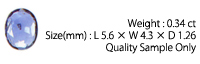
6. Windowing, Uneven Color, Richness of Color
Two zones of blue color and three colorless areas can be seen near the center of this stone. Uneven color results from a complex interaction between the location of color in the stone and how the stone is cut, while the richness of color depends on the fineness of the rough material.
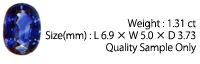
7. Inclusions (Internal Characteristics)
A round shape can be seen near the top of the table surface. This is an eye-visible inclusion, and it affects the beauty grade even in colored stones. It is necessary to confirm the presence of inclusions by varying the lighting, method of viewing, and the viewing angle while examining the stone under magnification.
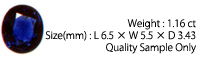
8. Fluorescence
The fluorescence seen in certain rubies, diamonds, and other gemstones is an element that can either enhance or detract from a stone’s beauty.
JUDGING QUALITY
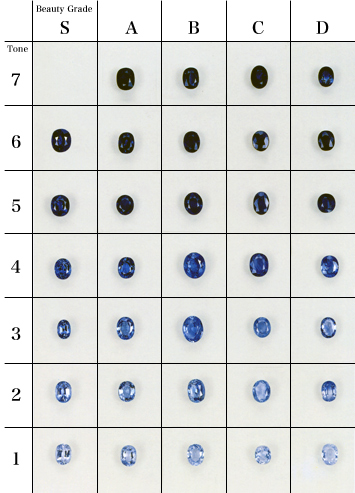
Sapphires with a tone of 5, a high level of transparency, and a brilliant quality are considered attractive. Sri Lankan material fits this description, and in this regard it is superior to stones from other sources.
When viewed under weak lighting, small sapphires appear blackish. Beauty will particularly suffer in stones with a tone higher than 6 if their transparency is low. In fact, under poor lighting conditions a tone of about 4 will appear more attractive. In the west, darker stones tend to be preferred, and prices for these may be high-but, a high price cannot be justified is a stone’s transparency is poor.
In one-carat sizes, dark blue (tone7) sapphires will not shown an attractive mosaic pattern, but in larger gem-quality sapphires, refraction and reflection caused by the facets create a mosaic pattern of deep and light blue. For large sapphires with tone 7, such as those from Myanmar, it is important to judge quality based on the fineness of the balance of the mosaic pattern.
QUALITY SCALE
SRI LANKAN SAPPHIRES
Heated
HOW TO CHOOSE
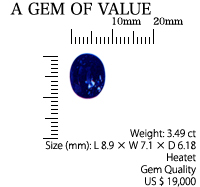
Along with diamond, emerald, and ruby, sapphire is referred to as one of the “Big Four” gemstones. Of the Big Four, Sri Lankan sapphire can be obtained at a relatively reasonable price. In gem quality, it is probably best to purchase a basic design with a stone of about 3 carats. In jewelry quality, a lighter stone that is sufficiently blue under weak lighting is recommended over darker stones. Sri Lankan material is commonly color-zoned, so it is important to confirm the fineness of the color seen face-up, avoiding stones that lose beauty in this position. One can find Australian material priced in the $100 range for 3-to 5-carat stones, but these have an almost-black blue color that is totally lacking in beauty. Some darker stones such as this may even resemble black onyx, and are nowhere near beautiful. Even though these may be considered accessory quality, they should be avoided altogether.
The value of a three-carat-size Sri Lankan sapphire of jewelry quality is approximately US $3,500 for the stone alone (2004).
The 3 quality zones as they appear in the quality scale
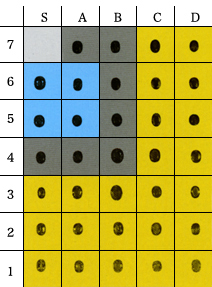
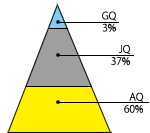
Quantity distribution of gems that are polished to 3-carat size
| VALUE INDEX | ||||||||||||||||
| ||||||||||||||||
 | ||||||||||||||||
|