
This gemstone has a rich history, and is said to bring prosperity.
The common term “turquoise blue” is derived from its beautiful characteristic blue color.
The history of turquoise is certainly a long one, with turquoise beads dating back to 5000 B.C. having been discovered in Mesopotamia (modern-day Iraq).
It was originally called callais, meaning “beautiful stone”. The word “turquoise” was not used until the 13th century, when this blue stone reached France by way of the merchants of Venice. The French buyers referred to it as “the stone from Turkey,” bringing the word turquoise into common usage.
The premier source of turquoise is Iran, and even today Persian turquoise is recognized as the highest quality. In the West, large pieces of turquoise are often set in jewelry surrounded by diamonds, while smaller stones are used as accents for other large gemstones.
There are two regions in the world that have a deep historical connection with turquoise. One is the Middle East: in Turkey, Egypt, Iraq, and Iran (Persia), turquoise has long been valued as a stone that brings good luck. The other area with a deep relationship to turquoise is New Mexico in the United States. The ancient people of what is now Mexico extolled turquoise as a priceless stone, and held it in higher regard than even gold. Despite the collapse of the Meso-American civilizations, this stone contained to be the favorite of the Pueblo and Navajo Indians who inhabited the region.
Currently, the state of Arizona produces large quantities of turquoise. Today we see natural Persian turquoise like the one shown in the photograph to the next page, as well as material that has been treated by impregnation of the whole stone with acrylic resins to improve color and prevent alteration over time.
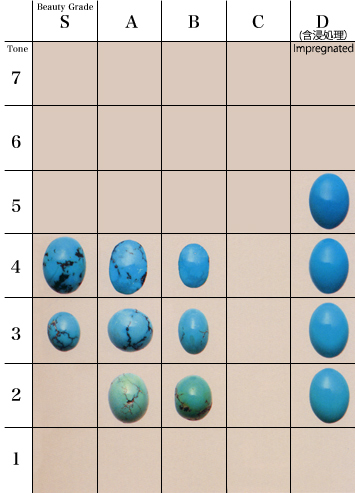
The finest quality of natural turquoise is a pure sky- blue, and a tone of 4 or 5 is considered best. Greenish hues detract from the stone’s beauty, lowering its value. The presence of matrix is a matter of personal preference.

Ring, Platinum
Turquoise 1 pc
1.78 ct
Impregnated
Diamond 8 pc
0.09 ct
US $1,200
Name of mineral : Turquoise
Mohs hardness : 5~6
Refractive index : 1.610~1.650
Specific gravity : 2.76

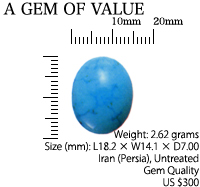
Weight: 1.20 grams
Size (mm) : L 17.0 x W 10.1 x D 4.56
Untreated
Gem Quality
US $160
COUNTRIES OF ORIGIN
The most important source of turquoise is the Nishapur mines in Iran, which produce large quantities of the highest quality material. Much of the turquoise from sources other than the Nishapur mines will become greenish or whitish within a year, even if it was a beautiful blue at the time it was mined. Therefore, turquoise stones are often impregnated with acrylics and other resins to prevent discoloration. Turquoise from the Sinai Peninsula can be superior in quality to the Nishapur material, but most of it is whitish and tends to break easily, while Mexican material has a characteristically dull color.
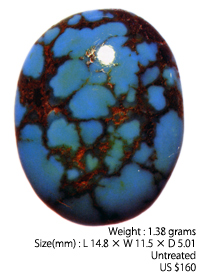
Iran (Persia)
The turquoise shown above, from Nishapur in Iran, was polished over 20 years ago, but it has maintained its naturally beautiful sky-blue color. Regarding the discoloration of turquoise, there are examples of royal crowns and scabbards from hundreds of years ago that are imbedded with dozens of pieces of turquoise that do not match in color. Assuming that the colors were matched at the time the stones were set, these differences can be attributed to the discoloration of the carious stones over several hundred years. Some pieces retained their color, while others turned greenish. It is an interesting phenomenon that different pieces if turquoise may or may not change color under the same conditions.
Arizona
Turquoise from Arizona is less durable than the Persian material, with some material containing a spider web-like matrix. Arizona material is usually fashioned after being impregnated with a clear acrylic in its rough state, since much of the material will change color over time.
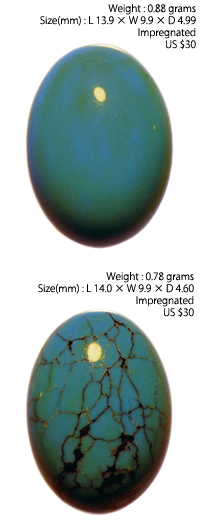
China
The majority of turquoise from China contains matrix and is dark in color. As with Arizona material, it tends to be fragile, so acrylic impregnation is usually necessary. Much of the material is green, and it is used in lower-priced pieces such as chokers. Most of the Chinese material is not very attractive.
JUDGING QUALITY
First it is necessary to confirm whether the piece is a natural Persian stone or one that has been treated by impregnation with acrylics or the like. The quality scale to the next page consists of untreated Persian stones and impregnation-treated stones from Arizona. Untreated Persian material will be assigned one of the five grades from S to D, depending on beauty. In the chart to the right page, grades S, A, and B are untreated Persian turquoise, which are rarely seen in the marketplace. Because stones from Arizona and China will discolor and lose their beauty if left in their natural state, treatment is almost routine. In this book such stones are considered accessory quality and assigned a beauty grade of D.
Second, with regard to judging matrix, untreated Persian turquoise with well-balanced matrix is ranked in the same manner as comparable stones with not matrix. An unattractive matrix pattern, however, will lower the quality.
Finally, common deciding factors in the quality of both untreated Persian and acrylic-treated material are the presence of greenish hue, and the appearance of the stone.
QUALITY SCALE
TURQUOISE
Untreated/Impregnated
HOW TO CHOOSE
Wearing a pendant or ring of superior gem-quality untreated Persian turquoise is an elegant luxury. However, such material is sensitive to chemicals and may change color, so strict care is necessary.
Acrylic-impregnated turquoise is accessory quality, but there is little worry of discoloration, and it can be considered less susceptible to chemical damage than untreated material. There are infinite variations in the tone of the blue color and matrix patterns, but as the material is not scarce, this will not influence its value. Because the Mohs hardness is a relatively low 5 to 6, durability is a consideration when wearing turquoise. Also, it is important to beware of imitations as well as synthetics.
The value of a two-gram-size turquoise of jewelry quality is approximately US $130 for the stone alone(2004).
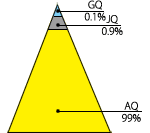
The 3 quality zones as they appear in the quality scale
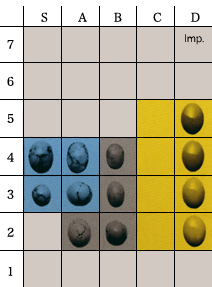
Quantity distribution of gems that are polished to 1-carat size
| VALUE INDEX | ||||||||||||||||
| ||||||||||||||||
 | ||||||||||||||||
|