
Among brilliantly shining diamonds, melee can play a supporting role to other gemstones, or a number of them may be set together to become beautiful jewelry.
“Melee” refers to small diamonds of less than 0.2 carats, and these are considered separately from other diamonds. Melee diamond is used in jewelry that is designed with several diamonds set together, or as side stones used to emphasize other colored stones. In fact, melee diamonds are used in almost all of the jewelry appearing in this book, so it is important that they not be overlooked when discussing gemstones.
After the Second World War, melee diamond was polished in Antwerp, Belgium, as well as in Idar-Oberstein, Germany. But due to production costs rising with the economic resurgence following the war, Idar-Oberstein has since lost its place as a diamond cutting center. Meanwhile, India’s polishing production grew rapidly during the 1960s. Progress has continued due to factors such as low production costs, outstanding management, and a traditional understanding of jewelry, with over one million people involved in the polishing industry during its peak. Even now, India represents over 90 percent of the world’s melee diamond polishing industry in production quality.
Incidentally, the melee diamonds that are supplied to India by De Beers, the diamond syndicate that distributes about 70 percent of the world’s rough diamonds, are rough stones that take time to polish because of their small size and irregular shape. Melee rough with good appearance and uniform size is sent to polishing factories in Bangkok, Thailand. Currently there are about 5,000 cutters in Bangkok, producing melee diamond such as those on the next page that are superbly cut from high-quality rough. Large quantities of full-cut melee with 58 facets for use in high-end jewelry, as well as single-cut melee diamonds used in expensive watches, are polished in Bangkok, attesting to the high quality of cutting there.
It is thanks to the low production costs in India and Thailand that we can currently purchase a piece of jewelry containing a number of fairly high-quality melee diamonds at prices as low as $2,000 to $3,000.
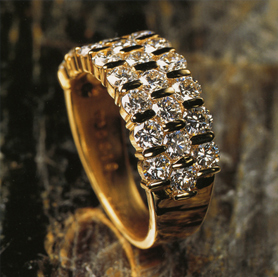
Ring, Gold
Diamond 25 pc
2.19 ct
Untreated
US $7,000
Name of mineral : Diamond
Mohs hardness : 10
Refractive index : 2.417
Specific gravity : 3.52

3,417 pc, Total Weight: 61.67 ct
Size (mm) : Diameter 1.4 to 2.5
Untreated
Gem Quality
Quality Sample Only
TYPES OF ROUGH AND QUALITY OF MELEE DIAMONDS
There is infinite variety in the shape, color, and quality of melee diamond rough, with differences depending on the country and specific mine of origin. Shapes include octahedral that look like two pyramids joined together, die-shaped cubes, and irregular shapes. Colors range from colorless to yellow, brown, and green coloring the whole stone or just a thin layer near the surface. The amount and types of inclusions also vary greatly. There are many ways of classifying these, but in order to make it easier to distinguish the quality of cut melee diamonds, we will classify the rough into three categories, just as we did with rough brilliant diamonds.
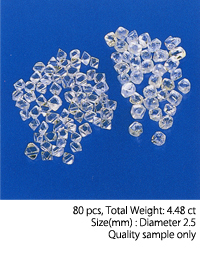
Sawable
Sawable melee diamonds are relatively easily polished, and can be fashioned with an exceptional cut. However, when polishing an octahedron, more than half becomes powder and is lost. When cut into diamonds for gemstone use, the yield for each rough stone is about 42 to 43 percent. If a cutter attempts to increase that ratio, for example, to somehow preserve 45 percent of the weight, the cutting angles and shape become less than optimum, resulting in a loss of brilliance. An experienced buyer will be able to identify this and use it as a bargaining point.
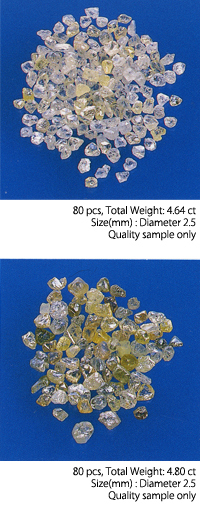
Makable
Makable rough and near-gem material together represent 80 to 90 percent of all gem diamond rough. Because shapes vary considerably, careful attention must be given to each stone as to how it will be polished. The lower the quality of the stone, for instance, the more likely it may have a direction of uneven hardness, causing problems during the cutting process. The ability to polish such a stone to its optimum brilliance and beauty depends on the skill of the cutter. The weight loss for makable rough is around 75 percent.
Near-Gem
Near-gem diamonds are industrial diamonds that are too low in quality to be used as gemstones. One example is Australian rough, which is often brownish, and polishing is said to take up to three times as long as material from other sources. Even in rough stones as small as melee, the price of high-quality sawable material is dozens of times greater than that of near-gem material. As with other gems, an understanding of the rough will allow better insight into the complete picture of a diamond’s quality.
JUDGING QUALITY
Even in melee diamond there are considerable differences in quality. The main factor in judging melee quality is the beauty of the brilliance. The key to a beautiful brilliance is the fineness of the rough material and the quality of the cut and finish. Melee with a beauty grade of S has beautiful brilliance, and jewelry made using this type of melee diamond will shine with a superior beauty.
The difference in price between melee with beauty grades of S and D is usually about four times, but in extreme cases it may approach ten times. Seeing the same carat weight of S and D material being sold as the same type of diamond can be a source of confusion for the consumer. For example, imagine a ring with 1 carat of gem-quality diamonds and a market price of $5,000. To purchase this at $3,500 would indeed be a bargain. However, a ring with 1 carat of accessory-quality melee and market price of $1,000 being sold at $2,500-as 50 percent off of $5,000- is clearly a case of unfair marketing. It is important to purchase from a reputable merchant after having discussed the quality, rather than one who markets inferior goods as a bargain.
HOW TO CHOOSE
As mentioned before, the life of a diamond lies in the beauty of its brilliance. The same holds true in the case of smaller diamonds, and when similar quantities of high-, medium-, and low-priced material are compared, it becomes easy to see. Jewelry quality is sufficient for jewelry in the $1,000 price range, but for that priced over $3,000, gem quality is recommended. The brilliance of these diamonds will be enjoyed with each use, and such jewelry is a pleasure to wear. Also, as soon as one appreciates the merits of diamond brilliance, accessory-quality material tends to look drab in comparison.
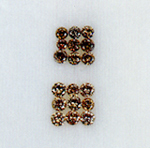
Single-cut melee diamonds are used in high-quality watches, with stones of around 1.3mm in diameter displaying more brilliance than brilliant cuts. The time may come again when single-cut melee will be used in rings and other jewelry.
The value of a 0.03-carat-size melee diamond of jewelry quality is approximately US $40 for the stone alone (2004).
QUALITY SCALE
DIAMONDS
Untreated

Aside from colorless to light yellow diamonds that are enjoyed for the beauty of their brilliance, dispersion, and scintillation, large amounts of brown diamonds from Australia have entered the market since the late 20th century. Currently, they reportedly account for 40 to 50 percent of total diamond production. The above photographs show dark (tone7) and medium (tone5) brown diamonds. Some large, attractive brown diamonds with exceptional color may be called “champagne-“ or “cognac” diamonds, but most brown diamonds are quite common and therefore moderately priced.
The 3 quality zones as they appear in the quality scale

Quantity distribution of gems that are polished to .03-carat SIZE


| VALUE INDEX | ||||||||||||||||
| ||||||||||||||||
 | ||||||||||||||||
|