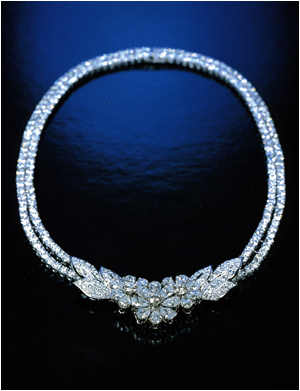
Wearing this necklace by itself would not be appropriate.
This necklace is the type of jewelry worn when dressing up in a formal evening grown and attending a banquet, matched with earrings like the ones shown below and an appropriate ring and bracelet. There are no upper limits to high-end jewelry. Setting a ten-carat, gem-quality Mogok ruby in the center of this necklace, with large diamonds to each side, would put its price at several million dollars. In the realm of important jewelry (jewelry with an estimated auction price of several hundred thousand dollars), the size and quality of the gemstones largely determines the value of the price. Although the average person has no connection to such pieces, there may be instances where splendid jewelry of this type is worn by actresses during the shooting of an elegant scene in a motion picture. Wearing this necklace by itself would not be appropriate.
The diamonds in this necklace have a brilliance that matches well to the unaided eye, with no defects that are visible under a 10-power loupe. Obviously, this jewelry was made to the manufacturer’s standards with materials that are beautiful and without defects, matched in shape and brilliancy. If only color and clarity grades had been considered, and diamonds with D or E color and VVS clarity were simply gathered and put together, the resulting necklace would probably be judged as having uneven brilliance.
Grades are useful for establishing standards for lower limits, such as “G color and VS2 or better, with no defects such as black inclusions.” When matching stones, however, it is necessary to realize that simply adhering to grades misses the point. When jewelry eventually reenters the market (other than in the case of large main stones), what matters is that the gemstones balance well as components of the jewelry, not the details of the grades of each individual stone.
The earrings shown below match well with this necklace. They are traditional earrings that were created in the workshops near the Place Vendome in Paris. Worn with formal dress, they are a style that hangs elegantly and provides a sense of comfort, not only to the wearer, but also to everyone who sees them.
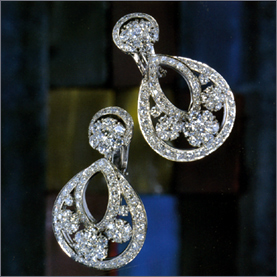
Earrings
Van Cleef & Arpels
950 Platinum
Diamond
Size (mm):L38 x W23 x H13 each
Important Diamond Necklace
Van Cleef & Arpels
Metal : 950 Platinum
Total Weight : 78 grams
Size(mm) : L403 x W19 x H9.4
Diamond
Untreated
Gem Quality
GEMSTONE WEIGHTS
ARE NOT STAMPED
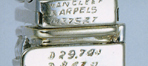
The hallmark that guarantees the quality of a piece of jewelry is necessary, but other than for especially valuable main stones, gemstone weights do not need to be stamped. The quality of gemstones is judged based on beauty, the presence of defects, and size-it is a mistake to put emphasis on weight. Carat weight is used as a reference for size, but many thickly cut stones are simply heavy, and lack beauty. Keeping track of stone weights during the manufacturing process is important from a quality control standpoint, but it only needs to be kept as a record of specifications for backup purposes.
Stone weights are sometimes stamped in jewelry to the third decimal place, which is even more unnecessary. The third decimal place is basically an insignificant number. Differences in value for gemstones of the same size can be ten times or one-tenth, depending on beauty, but a 0.01-carat weight difference has no bearing on the quality and value of the stone. The fundamental use of carat weight is as a reference to represent the size of different gemstones, such as in “one-carat size,” or “three-carat size.”
In the sales competition of low-quality jewelry, promotions are often based on the notion of “so many carats at such a low price.” This should be interpreted as “such large and low-quality garbage.” The reason for not stamping carat weights in jewelry is not to deceive the consumer.
Other than for the purpose of confirming the identity of special gemstones, reliance on carat weight will cause one to lose sight of the true value of gemstones.

CONSTRUCTION
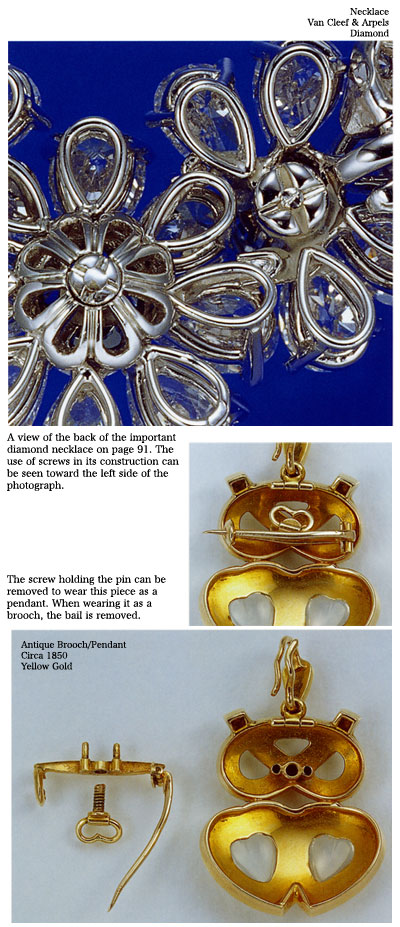
USING SCREWS
The quality of jewelry is determined by the original conception. Several components parts may be made separately, and sometimes a construction that uses screws to join them together is best. If so, the key to quality lies in making this decision at the time of conception. An attempt to make the jewelry as a single piece may place limits on its form, or prevent thorough finishing of certain areas, thus preventing the possibility of making a beautiful finished piece.
Construction using screws allows gemstones to be set in places that would otherwise be impossible. Its other advantages include the capacity for three-dimensional construction and improved durability. The only disadvantages are that it is labor intensive and requires a high level of skill, resulting in higher manufacturing costs. Yet if screws can be used to make something of more value than the difference in cost, then it is a very valuable technique indeed.
Construction using screws is often seen in antique jewelry from the era of England’s Queen Victoria (1837-1901). The precision and durability of many of these pieces is impressive.
To improve the beauty of the finish in jewelry with a three-dimensional style that combines several prong settings, the stones are initially set so that the settings can be polished, Afterwards, the stones are removed, the settings are soldered together, and the stones are reset.