Enchanted by the beauty of its dazzling colors,
the ancient Romans considered opal the gemstone of love and hope.
The name “opal” comes from the Latin opalus, meaning “precious stone,” and ancient Romans thought of opal as the gem of love and hope. The ancient Roman writer Pliny observed that it is as if the flaming reds of ruby, the magnificent greens of emerald, the golden yellows of topaz, the deep blues of sapphire, and the rich purples of amethyst become one within opal.
Like quartz and agate, opal is primarily composed of silicon dioxide, but it also contains 3 to 10 percent water by weight. Unlike most other gems, it is an amorphous (non-crystalline) mineral. Created slowly by the forces of nature between 120 million and 30 million years ago, opal occurs in abundance near the surface of the earth. However, stones showing the beautiful rainbow of sparkling color are scarce: Each of these is a rare and valuable gemstone with its own unique character.
The cause of the sparkling spectral colors (play-of-color) in opal was not understood until the 1960s. Opal, which appears fine-textured and homogeneous to the naked eye, is actually an aggregate of extremely tiny spherical or irregular particles. Opals that exhibit play-of-color are made up of spherical particles of uniform size that are packed together in an orderly fashion.
Depending on the size of the particles, diffraction occurs, resulting in play-of-color. When the particles are small, purple can be seen; when medium-sized, green; and when large, red. Light opal is often called “white opal,” but as a general rule this is not correct. “White opal” should be used to describe opals with a white or milky body color, and this does not apply to the highly transparent crystal opal.
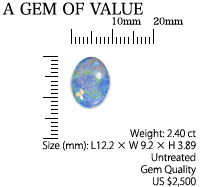
The light opal in this photograph is one of gem quality, exhibiting bright, vivid colors. Gem-quality opals will show these bright, vivid colors in an attractive pattern, and have a good shape. Within gem qualities, those showing strong red colors will command a premium, with strong oranges and greens following in order of desirability. Opals that are cloudy or dull are of low quality, regardless of the colors they exhibit.
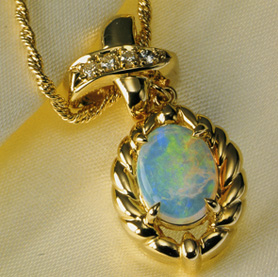
Pendant, Gold
Light Opal 1 pc
0.65 ct
Untreated
Diamond 4 pc
0.03 ct
US $650
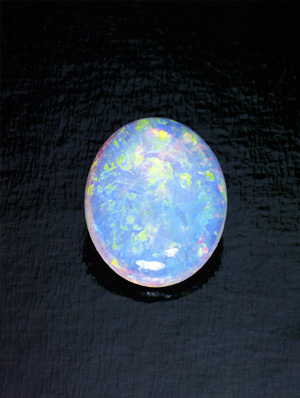
Name of mineral : Opal
Mohs hardness : 5~ 6
Refractive index : 1.450
Specific gravity : 2.15
Weight: 5.02 ct
Size (mm) : L 15.5 x W 12.9 x D 4.50
Untreated
Gem Quality
US $5,500
SOURCES AND VARIETIES
Australia is currently the primary source of opal, proving an estimated 90 percent of total world production. The chief producing state differs with each variety of opal.
Black Opal
Light opal and black opal are broadly classified by body color. Light opal refers to those with a body color that is colorless or white to medium-gray in tone, while black opal refers to those with a body color that ranges from dark gray to black.

Fire Opal
The commercial sources of fire opal are the Querétaro and Magdalena areas in Mexico, where mining started in 1870. Due to its high water content, fire opal has a low density. Quite a bit of the so-called “Mexican opal,” with its remarkable play-of-color, was imported by Japan in the 1960s, and some of these opals were subject to surface cracking due to dehydration.
Light Opal
Coober Pedy and Mintabie in South Australia are the sources of most of the world’s light opal, with rough material being exported to Hong Kong and Germany for polishing. Thus, most of the light opals sold in Australia are polished in Hong Kong and Germany and imported back into Australia. Since shipping costs for gemstones are low, merchandise easily finds its way to the optimum polishing centers.
Boulder Opal
Boulder opal is opal that is polished leaving the ironstone matrix found in the rough material as part of the finished stone. Central Queensland in northeast Australia contains several hundred square kilometers of boulder opal fields. Value is determined by the intensity of the play-of-color and how the matrix is incorporated into the stone. The value of boulder opal is about one-third that of black opal of similar beauty.

JUDGING QUALITY
The criteria for judging the quality of gemstones always come down to beautiful brilliance and color. Depending on the gem, one or both of these elements may be the deciding factor. Superb brilliance is the key factor in diamonds, whereas color is paramount in emeralds or jade. Opal is a good example of a gem where combined brilliance and color determine the beauty grade. Strength of color and vivid clarity are absolute requirements for a fine opal. This brilliant and dazzling appearance may even be called the “brilliancy of color” in opal.
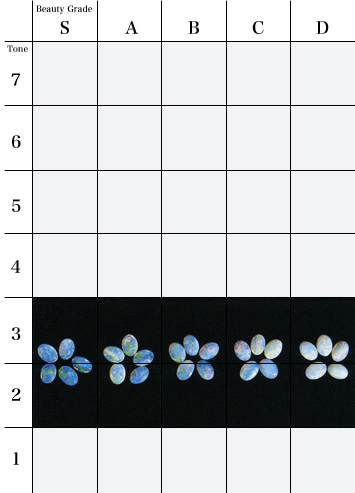
As shown in the quality scale to the right, an opal with dull color lacks beauty, resulting in a beauty grade of C or D. An opal showing a lot of red is considered desirable, assuming a clear brilliancy. This means that an S grade opal exhibiting red is extraordinary, but a D with red is still poor quality, and the red color becomes meaningless. Also, it is generally true that a fine blue S will be more attractive than a fine red A.
Opal’s low hardness of 5 to 6 , coupled with its high water content, make it susceptible to crazing (cracking) when exposed to heat. Careful handling is extremely important. It is also important to remember that doublets (assembled opals) and treated black opals may look attractive, but have little value.
QUALITY SCALE
LIGHT OPALS
Untreated
HOW TO CHOOSE
Since light opal is a relatively inexpensive gem, it is preferable to choose one of gem quality to be able to enjoy a jewel of the highest quality. Because differences in beauty are readily apparent when compared using the quality scale, it may be interesting to perform a small test on an available opal to see whether or not it is of the quality used in affordable accessories.
When purchasing light opals overseas, ask to be shown opals of high, medium, and low prices in the same size, ascertain the brilliancy of color, and try to make a value determination. The value of gems of the same general quality will not differ much, regardless of where in the world you are. In specialty stores where it is believed that the quality of design and craftsmanship are responsible for relatively high prices, the reality is that the quality of material is usually high and prices are within reason.
The value of three-carat-size light opal of jewelry quality is approximately US $800 for the stone alone (2004).
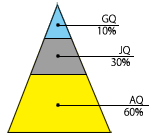
The 3 quality zones as they appear in the quality scale
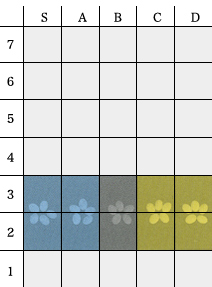
Quantity distribution of gems that are polished to 3-carat size
| VALUE INDEX | ||||||||||||||||
| ||||||||||||||||
 | ||||||||||||||||
|