The solitaire ring brings out the essence of a single diamond's beauty
to the maximum degree possible.
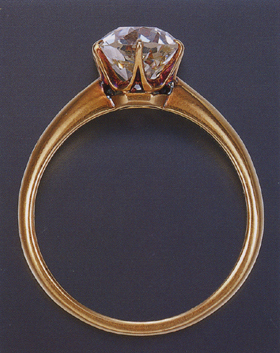
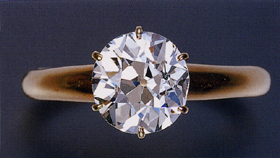
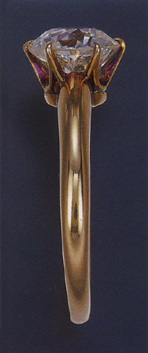
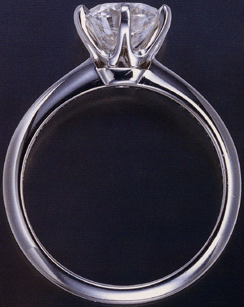
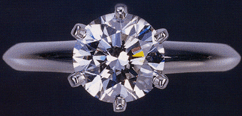
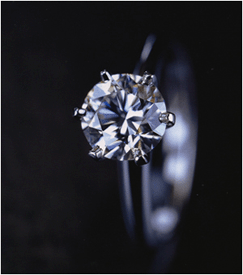
The Word “solitaire” is derived from the Latin solitarius, meaning “alone.” The solitaire ring is a style of jewelry that possesses the wonderful individuality of a solo musician. Completely different from the orchestrated effect seen in a pave-set ring, its beauty lies in prominently showcasing the personality of the soloist. A beautiful diamond combines crystal-clear transparency, a brilliance that shines strongly from within, dispersion showing a full spectrum of colors, and a well-balanced shape and form. More than any other style, the solitaire ring maximizes this essential beauty of a diamond. The diamond’s presence is highlighted by minimizing the appearance of the prongs and giving the shank (hoop) a thin, knife-edge shape. A careful look at the photograph to the next page shows six well-shaped prongs, evenly spaced, holding the diamond securely in place. This style originated from the producer’s desire to show off a beautifully sparkling diamond without the use of any metal, as if it were gently placed on top of the finger.
A photograph can only show a glimpse of a diamond’s beauty. This diamond’s 58 facets work with the reflection and refraction of light, creating a mosaic pattern that fills its entire face. Moving the diamond or viewing it from different angles causes the mosaic pattern to constantly change in a delightful display of beautiful scintillation. If you have a diamond on hand, try looking at it as you shine a penlight on it and move it around. This fascinating beauty can be experienced with any diamond larger than 3 millimeters (0.1-carat size) of jewelry quality or better. However, the sparkle will be lost if the diamond is not clean, or if there is insufficient lighting.
The solitaire ring is the standard engagement ring style. If you are having trouble deciding on a bridal ring, I recommend the solitaire because it best shows the beauty of a diamond. The main point is to find a stone that looks beautiful to you and to consult with a professional to make sure that there are no defects in the diamond, while choosing as large a stone as possible. The solitaire ring is a style that crosses all age barriers, with a classic beauty that is attractive and appropriate for any occasion.
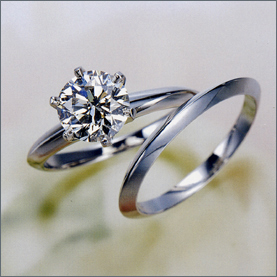

OLD EUROPEAN AND MODERN BRILLIANT CUTS
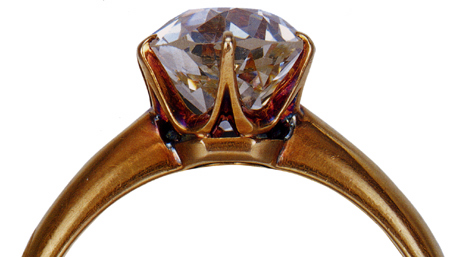
The ring shown to the right, courtesy of Mr. Kanji Hashimoto, was made in the late 19th century. Unfortunately, there is no maker’s hallmark stamped or engraved on this ring, making it impossible to tell who the manufacture is.
Another characteristics of this ring is the manner in which the diamond is cut. This is called an “Old European” cut, characterized by a small table, high crown, and large culet. This diamond’s brilliance has a noticeably different quality than that of a modern round brilliant cut. The main reason for the change in cutting style was the development, around the year 1900, of the ability to saw rough diamond crystals using a thin, flat slat coated with abrasive diamond powder. This technique allows octahedral diamond rough to be polished after first being separated into two pieces. During the era of the Old European cut, diamonds were polished directly from a single octahedral piece of rough, and the crown had to be left high in order to minimize weight loss. This is an example of how technical advances influence the cutting style of high-priced diamonds.
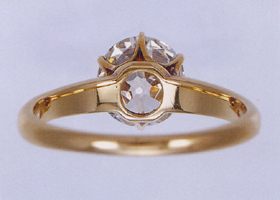
Looking at the ring from the back, note the large circular opening behind the diamond. This was done to allow as much light as possible to enter the gemstone from every direction.
The regular use of platinum as a jewelry metal did not start until the early 20th century. This ring is made of yellow gold. Yellow gold generally emphasizes the yellowish color of a diamond; and to avoid this, many pieces of diamond jewelry in the 19th century were made by actually covering the gold with a white metal, usually silver. Many such pieces can be seen in antique jewelry.