
The red color of ruby stirs the emotions,
and this stone is said to give the wearer extraordinary power.
Today, Bangkok, Thailand is famous as the polishing and trade center for ruby, but back in 1940 there were only about 200 to 300 cutters, most polishing zircons. Full-scale polishing of Thai ruby only did not begin until about 1960. Until that time, trade in Mogok ruby was flourishing, and material from Thailand was not considered important because most of it was dark and blackish. However, with the change of government and nationalization of gemstone mining in Myanmar, production declined drastically. This situation, combined with advances in heat treatment techniques to remove its blackish color, allowed Thai ruby to rapidly capture market share.
Light red corundum is sometimes sold as pink sapphire, but these are in fact light-colored rubies. These are sold under the name of pink sapphire because they are considered too light in color to be called ruby. However, it is essentially impossible to separate red corundum into ruby and sapphire using a given tone as a boundary. Borderline material might be called either ruby or pink sapphire, depending on the merchant. As a fundamental solution to such problems- and to enhance the credibility of the gemstone industry as a whole- all reddish hues of corundum, including lighter tones, should be included in the category of ruby.
In the second half of the 1970s, prices of gemstones in general were on the rise, and ruby was no exception. Particularly for small round and square rubies of 1.5 to 3.5 millimeters, which are indispensable in jewelry, greater demand from manufactures in Bangkok led to significantly higher prices. Gem-quality Thai rubies in sizes of 0.1 to 0.2 carats have increased tenfold in price over the last decade, bringing their prices close to comparably sized diamonds.

Ring, Gold
Thai Ruby1 pc
1.80 ct
Heated
Diamond 18 pc
0.56 ct
US $6,500

Name of mineral : Corundum
Mohs hardness : 9
Refractive index : 1.762~1.770
Specific gravity : 4.00
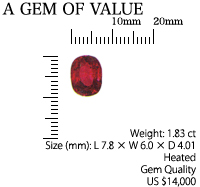
Weight: 3.14 ct
Heated
Gem Quality
US $40,000
RANGE OF HUES
To assess the quality of a Thai ruby, it is important to first determine whether it is red, red-purple, or reddish purple. Generally, gemstones have a certain hue depending on their source, and that hue becomes one of the characteristics of gems from that source. In the case of Thai ruby, color comes in a wide range, from an orangey red to a reddish purple.

Red
A pure red is considered the finest color, with stones of grade 6-S sometimes comparing favorably with the Mogok “pigeon’s blood.” It is difficult to judge whether stones of this type are of Thai or Mogok origin, and it is necessary to collectively consider indications such as inclusions and fluorescence in making a decision. Unfortunately, the color of a large portion of Thai material is too dark, with poor transparency and often a muddy appearance that limits them to jewelry-quality and accessory-quality stones of beauty grades B,C, or D.
Red-Purple (RP)
This is the typical hue for Thai ruby, with many Thai rubies falling onto this category. One of the characteristics of Thai ruby is that even as tone becomes light, hue does not change. This is in contrast to the characteristics of Mogok rubies, which show a more bluish color as they become lighter, changing from red to purple. However, Thai rubies with lighter tones lose their depth of color, resulting in an unfortunate loss of beauty.

Reddish-Purple (rP)
This is a red that is close to purple, with quite a bit of bluish hue visible. However, it is strongly red when compared to the blue-purple of a violet sapphire, falling well within the bounds of red. Attractive stones that would be an S grade within this hue have a beauty grade of B when judged on the scale for rubies.
JUDGING QUALITY
As shown in the preceding discussion of hue ranges, hue is important in judging the quality of Thai rubies. As stones shift towards blue, form red to red-purple to reddish purple, they are judged lower as far as ruby colors are concerned. In the case of reddish purple, even an extremely attractive stone is valued low as a ruby, having a beauty grade of B.
In general, most gemstones are more beautiful when they have a high level of transparency, but occasionally there are Thai rubies that lack depth of color, appearing “watery.” This is attributable to the material itself. When judging quality, ascertain the overall attractiveness through consideration of factors such as the shape and appearance of the stone, uniformity of color, and the presence of inclusions.
The quality scale to the next page consists of rubies chosen from red-purple stones.
QUALITY SCALE
THAI RUBIES
Heated

HOW TO CHOOSE
The rule of thumb in choosing a Thai ruby is to avoid to dark, blackish stones. This blackish color is usually not apparent in the strong lighting of showcases. Under such lighting, the red tends to become more prominent. Care must be taken to examine the stones in a shaded area away from bright lights. It is also necessary to remember that the color may appear very poor under fluorescent lighting, to the point that you may think you are looking at an altogether different type of stone.
Most small stones used as components in jewelry in the 1980s were from Thailand, with several stones often set together in band-type rings or other types of jewelry. A beautiful red can be achieved in Thai ruby even when cut to small sizes, so it is wise to choose jewelry such as band-type rings or brooches made with small stones that take advantage of this.
The value of a one-carat-size Thai ruby of jewelry quality is approximately US $2,500 for the stone alone (2004).
The 3 quality zones as they appear in the quality scale
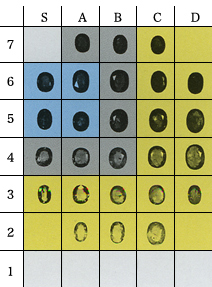
Quantity distribution of gems that are polished to 1-carat size

| VALUE INDEX | ||||||||||||||||
| ||||||||||||||||
 | ||||||||||||||||
|