
The value of use for a piece of jewelry is determined by how many times it is worn over a lifetime. If a piece costing $10,000 is worn five times a year for forty years, each wearing comes to $50. On top of that, forty years later the value of the piece still remains. If the price increases due to inflation, it is like wearing the piece for free and getting change. Furthermore, if there is a value of $10,000 for each wearing of the piece, that comes to a value of use of $2 million. In any case, the key to whether an appropriate choice was made lies in the number of times a piece is worn. Even if an engagement ring, which is not thought of as being worn often, is worn just a few times each year, that adds up to quite a number of times, and if its high-pronged diamond setting is matched to a band-type ring, the two can be worn and enjoyed together in a splendid and refined way.
In modern-day Japanese society, real jewelry is worn in daily life, but there are only two types of formal occasions where jewelry is worn. One is at celebrations and parties such as wedding receptions, and the other is during travel or at school functions. In the classless society of Japan, fancy parties such as those given in the West are nearly nonexistent, and there are no opportunities to wear extravagant necklaces or earrings. The jewelry trade in Japan has called for “creating occasions to wear jewelry,” but since there is no basis in that society for such occasions, in reality this would be difficult. Perhaps it would be most fitting to nurture and take advantage of the jewelry scene that conforms to the existing society and customs of Japan.
The appearance of a gemstone may change drastically depending on lighting conditions, causing stones to look beautiful under one type of lighting and lose their beauty under another. There are doubtless many people who have experienced disbelief when looking at a blackish ruby under the fluorescent lighting of their homes, wondering if it is really the same stone that they saw earlier under the bright spotlights of the stone showcase. Such a difference in appearance under different lighting is one of the characteristics of gemstones. Generally, red gemstones such as ruby are more attractive under incandescent lighting, while blue gems like sapphire show a more distinct blue color under fluorescent lighting. The rainbow-colored dispersion in diamond is displayed most beautifully when viewed in sunlight or bright artificial lighting. The buyer and wearer of a gemstone may or may not be the same person. In Japan, middle-aged to elderly women will often make purchase decisions for items of several thousand dollars on their own. This is probably due to the fact that in Japanese society, the wife is often in the fortuitous position of “finance minister” over the husband’s paycheck deposits. Also, the logic is that jewelry is something that will eventually be passed down to daughters and daughters -in-law, and therefore is not a frivolous use of money. In the United States, it is customary for a husband to buy jewelry as a Christmas present for his wife. Even in Japan, an engagement ring is purchased by the groom and presented to the bride. I believe it is advisable to spend three month’s salary for an engagement ring. Considering that an engagement ring, unlike other gifts, is something that will come back with the bride after it is given, it makes sense to invest wholeheartedly in an engagement ring that will express your love, even if it means cutting back in other areas for a while. For a bride who already owns a diamond, as elegant ring with a ruby, emerald, or sapphire of gem quality as the main stone is recommended.
The chart on the next page lists stones in order of their Mohs hardness, from diamond at 10 down to lapis lazuli and turquoise at 5 to 6. Other than emerald, gemstones down to amethyst at hardness 7 have no problems with durability under normal use. In spite of its hardness, emerald is fragile and must not be worn while emerald in activities such as sports, household cleaning, or gardening. An elderly woman I know wore an emerald ring continuously for two years, after which the stone was badly chipped and fell out of its mounting, having become a worthless piece. Apparently this person had worn the ring every day, even while working in her garden.
Even a diamond will become somewhat scratched after it is worn over a long period of time, a phenomenon that can be observed in pieces reentering the market. The original condition can be restored by slight refinishing, but about two percent of the stone’s weight will be lost. When buying a 1-carat diamond, it is advisable to keep this in mind and give yourself some leeway by choosing a stone of 1.10 or 1.20 carats, avoiding stones that are between 1.00 and 1.02 carats. Also, diamonds attract oils, causing surfaces to become cloudy and lessening their brilliance, so it is necessary to clean them every so often. The safest and most effective way to clean a diamond is to fill a wash basin with lukewarm water and brush the sides of the diamond with a soapy toothbrush. After rinsing, simply wipe it with a towel. Avoid washing jewelry directly in the sink to be safe in the unlikely event that a stone may come loose from its mounting. There is no need to worry about removing dirt from the back of the non-transparent stones jadeite, opal, turquoise, and lapis lazuli, but it is extremely important to clean the underside of all transparent stones just as with diamond. The reason for this is that the beautiful brilliance and color are affected by the refraction and reflection of light entering and existing from the bottom as well as the top of the stone. It is wondering to enjoy one’s own gemstones while maintaining them in the finest condition.
Gemstone Hardness and Handling
| Gemstone Name, Hardness, Toughness | Use | Safekeeping | Cleaning |
|---|---|---|---|
 | No problems with normal wear, but hand creams and other oily substances are easily attracted and will cause a loss of brilliance. Take care to keep clean when wearing. | Keep rings separate. Surfaces may be scratched when two diamonds rub against each other. | Cleaning grease and oils with a toothbrush and mild detergent will restore brilliance. (Clean in a small washbowl.) Grime on the pavilion is especially hard to clean, and prone to buildup. Simply wiping with a soft dry cloth will usually restore brilliance. |
 | No problems with normal wear. | Keep away from diamonds. Keep rings separate. | Simply wiping with a soft cloth is usually sufficient. If the pavilion is dirty, clean with a toothbrush and mild detergent. |
 | No problems with normal wear. May chip or break if struck forcibly. | Keep separate from other rings to avoid collision. | Wipe clean with a soft dry cloth. If extremely dirty, clean with a toothbrush. |
 | No problems with normal wear. May chip or break if struck forcibly. | Keep separate from other rings to avoid collision | Wipe clean with a soft dry cloth. If extremely dirty, clean with a toothbrush. |
 | Aquamarine: No problems with normal wear. Emerald: Take care not to strike against hard surfaces. Remove rings when doing laundry or kitchen work. | Keep rings separate. Emerald rings should be checked periodically for loose prongs. | Wipe clean with a soft dry cloth. Aquamarine may be cleaned with a toothbrush and mild detergent if extremely dirty. Though the same mineral, emerald is more delicate than aquamarine, and ultasonic cleaners and detergents should not be used. |
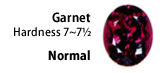 | No problems with normal wear. May chip or break if struck forcibly. | Keep separate from other rings to avoid collision | Wipe clean with a soft dry cloth. If extremely dirty, clean with a toothbrush, taking care not to drop. Large stones may chip. |
 | No problems with normal wear. Be careful not to strike larger stones against objects. May chip or fracture if struck forcibly. Avoid extreme changes in tempareture. | Keep separate from other rings to avoid collision. | Do not use ultrasonic cleaners. May fracture. Wipe clean with a soft dry cloth. If extremely dirty, clean with a toothbrush. |
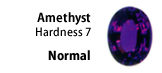 | No problems with normal wear. Be careful not to strike larger stones against objects. May chip or fracture if struck forcibly. Remove jewelry with larger stones when doing laundry or kitchen work | Keep separate from other rings to avoid collision. | Gently wipe clean with a soft dry cloth. If extremely dirty, clean with a toothbrush. |
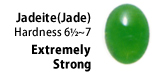 | No problems with normal wear. Will not chip or crack if struck moderately, but surface may be scratched, | Keep separate from other rings to avoid collision. | Wipe clean with a soft dry cloth. If extremely dirty, clean with a toothbrush. |
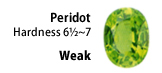 | No problems with normal wear. May chip or fracture if struck. | Keep separate from other rings to avoid collision | Wipe clean with a soft dry cloth. If extremely dirty, clean with a toothbrush. |
 | Not recommended for rings. Care should be taken not to strike against surface. | Keep separate from other rings to avoid collision | Gently wipe clean with a soft dry cloth, making sure there is no dust or dirt on the cloth. If extremely dirty, clean with a toothbrush. |
 | No problems with normal wear. May chip or fracture if hit. Use cautionm as surface may scratch if struck or rubbed against objects. | Keep separate from other rings to avoid collision | Gently wipe clean with a soft dry cloth, making sure there is no dust or dirt on the cloth. Do not rub hard. |
 | Be careful not to strike the stone or even around the stone against the surfaces. Do not drop. Extremely weak to impact. May dehydrate if exposed to high temperatures, causing cracks or fractures to appear. | Avoid dehydration. Keep in a place with constant humidity. | Wipe gently and carefully with a soft dry cloth. If extremely dirty, consult your jeweler. |
 | No problems with normal wear, but surface scratches easily, so use caution. | Keep separate from other rings to avoid collision. | Wipe clean with a soft dry cloth. If extremely dirty, clean with a toothbrush. |
 | Will gradually discolor if exposed to dirty water or oils. Remove when doing iaundry or kitchen work | Due to its porous nature, keep away from chemicals. | Gently wipe clean with a soft dry cloth. |