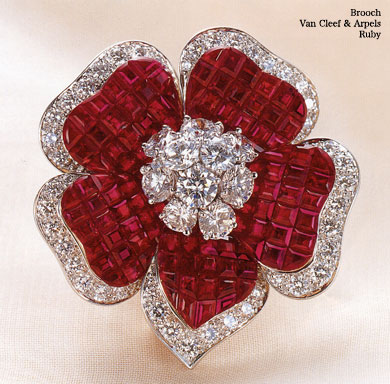
A distinct six-rayed star appears when light strikes this gemstone’s surface. Tiny, needle-like “silk” inclusions cause the star to appear. Some rubies exhibit a six-rayed star when light is shined on them, an effect known as “asterism.” The star, which appears on the surface of a cabochon-cut ruby, will move when the gem is rocked. […]
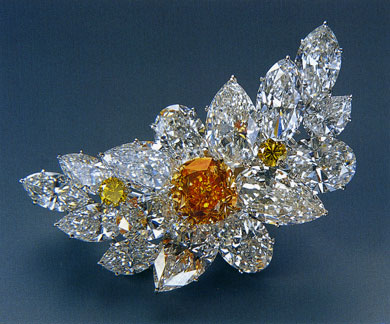
Only those yellow diamonds with a deep, beautiful color are given special recognition and called “fancy” yellow. There are said to be more than 20 polished fancy yellow diamonds in existence that weigh over 100 carats. Most of these were mined in South Africa. India and Brazil were the main sources of diamonds for many […]
Color is critical in fancy-colored diamonds, so bringing out the deepest possible color is a measure of the cutter’s skill. The pink color of fancy pink diamonds is actually a light red. Different tone levels of pink can be thought of as similar to the colors achieved by gradually adding water to a red paint. […]
Due to very limited mining production, these diamonds are mostly kept as heirlooms and recirculated through auctions. Though very rare, there are diamonds that are pink, orange, yellow (“canary” color), green, blue, and purple. Each color has its own pricing structure, separate from that of the more commonly seen diamonds that range from colorless to […]
Traditionally, the most favored color for sapphire is the rich and soft “cornflower blue” seen in Kashmir stones. Though there is virtually no mining in Kashmir now, sapphires that approach this color are found in Sri Lanka. Some of the sapphires that are mined in Sri Lanka (and recently in Madagascar) are not heated. These […]
In many cases, some imperfection will be visible in emerald. It is impossible for a cutter to avoid all of them when polishing a stone. Therefore, throughout history, oils have been used to mask flaws in emerald. If lasting beauty is what we seek, then untreated emerald is our only choice. A major source of […]
Diamond jewelry has three basic styles, depending on the size of the diamond used. Each possesses its own particular beauty. Diamond Quality Nature produces rough diamonds of varying quality. They are crystallized 150 kilometers under the earth’s surface under incredibly high temperature and pressure, and then brought to the surface by chance volcanic activity. Once […]
The increased production of gold and diamonds, following the discovery of gold in Australia and California in the mid-19th century and of diamonds in South Africa in 1866, has had a decisive effect on the quantity and quality of jewelry made since then. The late-19th century Art Nouveau designs that were an extension of the […]
Jewelry is redistributed through family inheritance or resale to other private parties, or a business may buy it back and make it into new jewelry for resale. No person would throw away jewelry, because regardless of its value as property, it has intrinsic value. There are the rare cases where jewelry is accidentally discarded, or […]
Jewelry has a history of being remade over and over again. From the crown jewels of England to the simplest ordinary ring, jewelry serves its purpose by being remade into styles that match the trends of the current era. It is said that the 21st century will bring about a society that is oriented toward […]
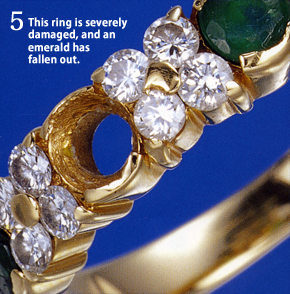
Jewelry is worn on the body, in a wide range of environments. Since it is not merely put into a case and displayed, jewelry wears down imperceptibly over time. Precious metals such as gold and platinum can become misshapen, and the polish of their surfaces can be dulled by scratches. Even diamond, the hardest substance […]