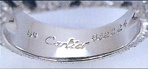
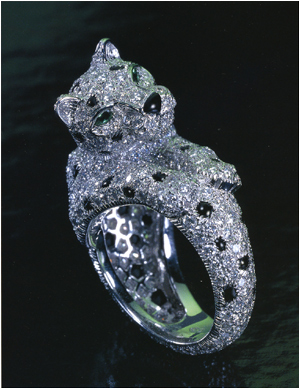
The small diamonds in this ring are pavé set, while engraving on the metal brings out the texture of the panther's coat.
This ring is a panther, set with small, pear-shaped emeralds for eyes. Flashing a brilliant green as they are viewed from different angles, they give the impression that the panther is sitting cautiously aware, facing an opponent. When this ring is placed on a finger, it is as if the tiny animal has taken to you, which makes it all the more charming. The neck can be angled twenty to thirty degrees, allowing the ring to be enjoyed in a variety of positions, such as a peacefully sitting pose or one where it appears ready to pounce.
The small diamonds in this ring are pavé set, while engraving on the metal brings out the texture of the panther’s coat. The back of the ring is open, finished in a four- and five- sided pattern to allow maximum light to enter the diamonds, and black onyx is set in various places to create the spotted pattern. The muscles on the panther’s back are flexed in a strong pose that adds volume to the ring, and the solid construction of the pivot that the neck turns on is clearly visible from the back of the ring.
Black onyx was used as an accent stone in many ornaments and pieces of jewelry during the Art Deco period (1920-1935). As a component, black onyx is an inexpensive yet very appealing material, capable of bringing out effects that cannot be expressed with platinum and diamonds alone. In 1914, Cartier was the first to use small pieces of black onyx as accents with pavé-set diamonds in a watch. Since then, this stone has been set in the bodies of panthers, as shown in the photograph to the next page, thecreating a style that is unique to Cartier.
The “Panthére” necklace shown below is an abstract form of this motif, emphasizing the spotted pattern of the panther’s coat. Four diamonds are securely bead-set in each of the slightly arched sections of the necklace. The sections are joined together with thick round pins, and durability is well considered. Although the piece gives an impression of weight, this is a basic necklace style that wears very comfortably
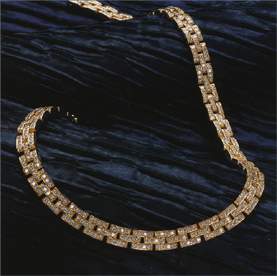
Necklace
Cartier
18K Yellow Gold
Diamond
Size (mm): L 400 x W 8.7 x H 3.0
Pavé-Set "Panthére" Ring
Cartier
Metal : 950 Platinum
Total weight : 24 grams
Size (mm) : L 22 x W 13 x H 32
Diamond
Untreated
Gem Quality
Emerald
Black Onyx
JEWELRY HOUSES AND ATELIERS
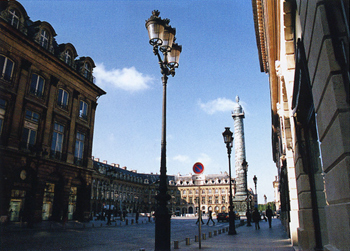
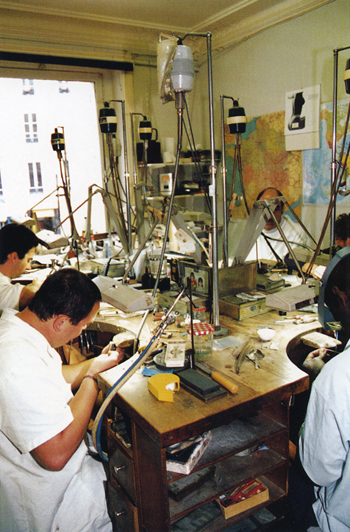
Since the 19th century, traditional jewelry houses such as Cartier have created superb jewelry by maintaining and strengthening their ties to the ateliers, or workshops. The Place Vendôme in Paris, bustling with first class jewelers, is surrounded by various workshops where artisans practice their craft at their benches as they have for generations. Entering these ateliers gives the illusion that one has gone back in time to a hundred years ago, when what is now antique jewelry was first being created. Using time-proven manual techniques that defy the machinery and technology of modern science, these workshops pit their skills against each other, giving life to jewelry of seemingly impossible craftsmanship. Competition between craftsmen within each atelier is keen, with each dedicating his lifework to the creation of pieces that will be a source of amazement to the people who wear them. In jewelry workshops throughout the world, whether in Paris, London, New York, or Tokyo, and regardless of scale, the same arrangement exists.
Inside an atelier near the Place
Vendôme, where artisans practice their
time-honored craft, and the words
"mass production" do not exist.
Atelier Saint Honore
Joaillier Fabricant, Paris
STONE SETTING, PART ONE
Stone setting is what unites gemstones and precious metals into a single entity. Whether envisioning the use of a particular gemstone, or assembling the finished piece, it is impossible to proceed without consideration of how the gemstone will be set. It is often said that the gemstones determine the design of jewelry, but it would not be an exaggeration to also say that the method of stone setting determines the quality of a piece’s style.
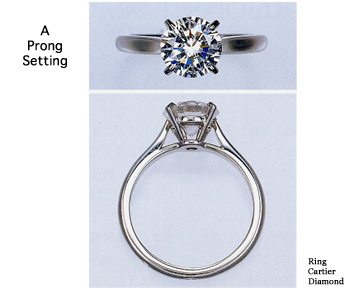
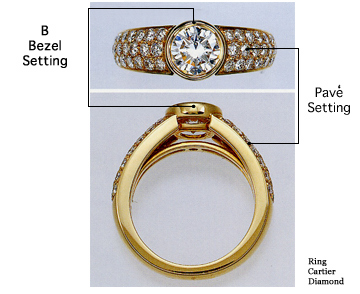
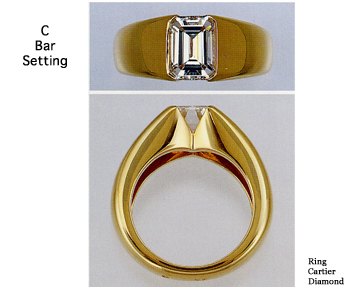
The three rings shown to the right illustrate the basic methods of stone setting. Ring A at the top is an example of prong setting. The large center gemstone in ring B is set in a bezel setting. A third basic stone setting method, bead setting involves setting the stones by pushing metal from the jewelry’s surface onto them. The small diamonds set in the shank of ring B are pavé set, which is an application of bead setting. Ring C shows a bar setting, in which a single stone is set between two parallel rails of metal.
Another basic stone setting method, loop setting, is explained with photographs in “Stone Setting, Part Two” in the next chapter. The various other stone setting methods can be though of as applications of the five basic stone setting styles.