The essential value of jewelry is derived from wearing it and enjoying its beauty and the comfortable feeling that it brings. A piece of jewelry has value because it suites your taste, and because it fits well and can be worn. Even when choosing jewelry as a gift, its value is derived from the joy and profound emotion that it arouses when it is worn by a loved one. Purchasing jewelry for the sole purpose of making a profit is a meaningless proposition.
Anyone would rather wear high-quality jewelry of beauty and elegance. If we discover that an acquired piece is of low quality, the desire to wear it will disappear immediately. Understanding quality and being able to correctly select jewelry gives one the confidence to wear it and allows the realization of its comfort. Everyone is interested in knowing whether or not the price of a favorite piece of jewelry matches its market value. The ability to judge quality is necessary to understanding value, because the value of jewelry is established by supply and demand at its
The quality of jewelry is determined by the quality of its conception, the manner in which the component materials are used, and the degree of care taken in its fabrication. Jewelry that is poorly conceived is especially doomed to fail, because such jewelry cannot carry out its most basic purpose, which is to be worn. Even if the materials used are not of the highest quality and it is not especially carefully made, well-conceived jewelry can still be a pleasure to wear.
Since gemstones are products of nature, their quality is controlled by the forces of nature. However, jewelry is conceived and created by people, so it can be said that jewelry’s quality is determined by the stores and manufacturers that produce it. Top management chooses the directors who establish the design objectives, the specialists who acquire the component gemstones used in the jewelry, and the craftsmen who set the gemstones and put together the finished piece. The intensions of top management therefore take shape in the quality of the jewelry made. It is apparent that beautiful jewelry such as the pieces shown in Chapter1 are made possible only through a fundamental commitment on the part of jewelry stores and manufacturers to create fine jewelry, regardless of the cost.
Jewelry is an implement that is used to adorn the body. No matter how superior its form and construction, a piece of jewelry so old that it can no longer be worn belongs in a historical collection. The basis for judging the quality of such an item is different from that for jewelry- its high value comes from its rarity as a historical piece. Even if it could be worn, one would not do so on a regular basis, out of fear that the piece might be ruined.
The value of jewelry does not fluctuate widely over the short term, but moves slowly over time within the currents of large-scale forces. Long-term changes in value are influenced by large variations in the popularity or the mining production levels of specific gemstone varieties. The market for amethyst, which was once a high-priced gemstone, saw its bottom drop out in the 19th century, after the discovery of mines in the Ural district of Russia and increased production from Brazil.
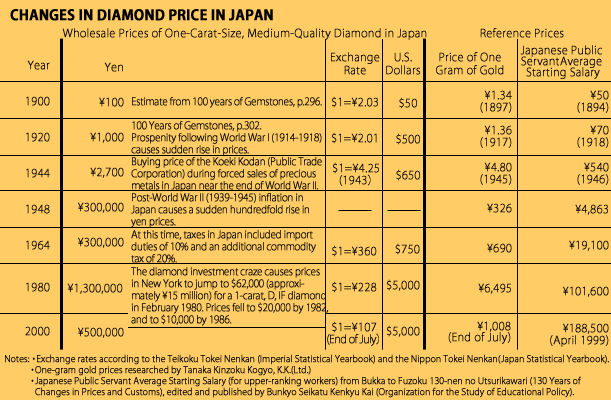
The chart below shows the change in the yen and dollar wholesale prices of medium-quality, one-carat-sized diamonds, in increments of approximately twenty years, from 1900 through 2000. The prices for 1900 and 1920 were taken from Houseki Hyaku-nen (One-Hundred Years of Gemstones)(Wakaba Kurabu, 1966). In those days, Japan was still months away from Europe by ship. The dollar prices shown were calculated from the yen prices, and may differ from Western estimates. When using the chart, it is also important to remember that diamond production during the early 20th century was 1/60 of the current amount, and that the cut of diamonds was quite different from the modern brilliant.
Comparing the numbers for 1900 and 2000, yen prices increased 5,000 times, from ¥100 to ¥500,000, while dollar prices increased 100 times, from $50 to $5,000. This is not because of a change in the value of diamonds, but instead should be thought of as a drop in the value of currency due to inflation. As a result of the prosperity following World War I, we see a sudden increase in 1920 prices. Rampant inflation in Japan following World War II caused a hundred-fold rise in yen prices between 1944 and 1948. The sudden rise seen in the 1980 figure was a temporary phenomenon caused by speculative demand in the United States. At the time, there was an amazing rise and fall in the prices of high-grade, one-carat-plus diamonds. This chart illustrates how gemstones, if bought during normal periods, can be worn and enjoyed, and will remain an asset.
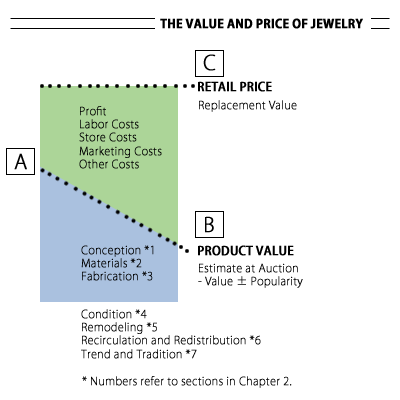
Expenses related to jewelry sales are a fact of life, whether for a store, catalog, television shopping network, or even an Internet-based company. If, for example, sales promotions such as invitations to dinner shows or overseas travel are used to sell jewelry, the cost is added to the jewelry. The dotted line going from A to B in the diagram shows the relationship of costs that make up the retail price, ranging from products with relatively high product value and low sales costs on the left (A), to the right, where sales costs are relatively high in relation to the product value (B). Which is chosen is up to the customer.
In the United States, it is common for consumers to insure newly-purchased jewelry for the retail price. An appraiser assesses the jewelry based on replacement value, rather than product value, to arrive at an amount that is close to the retail price.
One must avoid purchasing jewelry that is unfairly expensive, but disregarding the labor, storefront, and marketing costs associated with selling jewelry while trying to obtain the best value for yourself is not a commendable attitude. After all, it is safe to assume that stores emphasizing low prices when selling jewelry are not cutting back on their cost of sales or profits, but are simply carrying merchandise that is that much lower in quality. As seen in the “Changes In Diamond Prices” chart on previous page, one hundred years of history suggest a ling-term rise in prices. The smart way to buy jewelry is not to buy a low-priced, trendy piece, but to find a quality piece that you like and that you think will be appreciated when it is passed on, and to boldly purchase it when you have the available funds-even if you think it is a bit expensive.
Developing an eye for judging the quality of jewelry requires looking at as many prices of fine jewelry as you can and, if possible, purchasing fine jewelry and wearing it. If you purchase and wear one or two pieces of jewelry of the type that appear n Chapter 1, your judgment skills will surely improve, and as you compare other jewelry to the jewelry that you own, you will become a better judge of the finer points of jewelry quality.
Chapter 2 explores the three factors that contribute to the quality of jewelry- conception, materials, and fabrication- and continues with discussions on the condition of jewelry, remodeling, recirculation and redistribution of jewelry, and trend and tradition.
The price of newly-made jewelry (left chart, C) is established by retail stores and manufacturers, based on company policy and a consideration of the jewelry’s value. Setting prices is an executive-level administrative decision that involves a balance between the consumers’ perception of value, competition from other companies, and considerations of cost. Expenses such as the costs of labor, maintaining a store, and advertising are indispensable in making customers aware of the company’s product, having them appreciate it, and tying that to a purchase. These expenses are unnecessary when dealing with gold bullion, but are indispensable when selling jewelry.