
Diamond jewelry has three basic styles, depending on the size of the diamond used. Each possesses its own particular beauty.
Diamond Quality
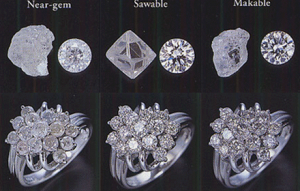
Nature produces rough diamonds of varying quality. They are crystallized 150 kilometers under the earth's surface under incredibly high temperature and pressure, and then brought to the surface by chance volcanic activity. Once reachable, they are extracted and some can be cut and polished to become the beautiful gemstones we know. A diamond's quality can be divided broadly into three categories (shown below).
AZAMI chooses only top quality gemstones. Most come from highly transparent sawable rough material with no defects, shown in the pictures at the top, and are cut to display the diamonds beauty to maximum effect. The pictures in the middle show medium quality diamonds, while the pictures at the bottom show stones, cut in the same style, that rarely show any brilliance. Use these illustrations as a reference to help when choosing truly beautiful stones.
 Stones of over 6mm possess a beauty and presence on their own and are ideal for solitaire rings.
Simplicity is their strength.
For diamonds of 4mm to 5mm we recommend rings employing a three-stone design. When set with skill,the three stones are integrated to produce an intensified brilliance and scintillation.
Small diamonds, when arranged in numbers side by side, unite to display a chain of sparkling beauty, impossible for individual stones of this size to produce. These rings also combine well with other rings.
 Sawable
This rough maerial is comprised of two pyamid-shaped stones combining to make an octahedron. Sawable rough material is characterized by its clean crystal shape and high transparency. Only 15% of all rough material mined falls into this valuable category.
Makable
The middle quality category provides rough material that is cut according to its shape. While high quality stones can be fashioned from makable rough, sometimes it results in poorer quality pieces that lack beauty.
Near-Gem
Primarily, this rough material is considered for industrial use as it lacks transparency, and it contains many fractures. Even after polishing, stones from this category do not display a beautiful brilliance and are therefore used for low-cost jewelry.