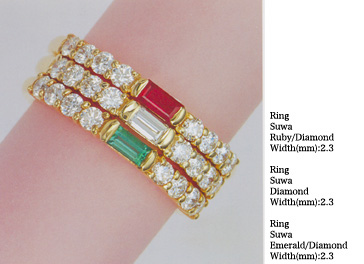
The emerald used in this ring is an untreated emerald from Zambia that has not been impregnated with oil or similar substances. The emerald’s color is influenced by the yellow gold of the setting, and it displays an exquisite green. Compared to emeralds from Colombia, Zambian emeralds have an especially strong bluish color that makes their beauty more prominent when set in yellow gold. If this ring were made totally of platinum, the beauty would have been diminished. More than a matter of superior make, this is the result of superior conception. The setting should not be used to conceal a gemstone’s defects, such as by hiding flaws under prongs, but the enhancement of a gemstone’s beauty through innovation is indispensable when creating superior jewelry.
Emerald is fragile and has a low hardness of 7 1/2 to 8, making it unsuitable for use in such eternity rings. Even ruby and sapphire, each with a hardness of 9, are best avoided in eternity rings. Diamonds are able to withstand a certain degree of impact, but after years of use they may become damaged. Eternity rings need to be enjoyed with care in order to preserve their everlasting beauty.
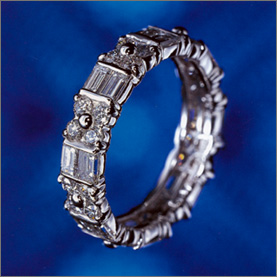
Suwa
950 Platinum
Size(mm) :L22 x W5.0 xH22
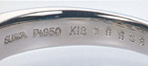
Suwa
Metal :950 Platinum /18K Yellow Gold
Total Weight : 7.2 grams
Size(mm) : L21 x W5.1 x H22

Untreated
Gem Quality
Diamond
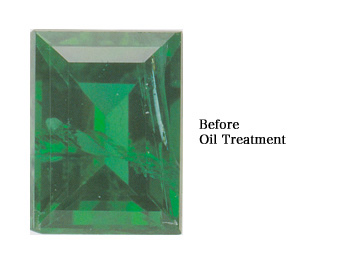
OIL-TREATED
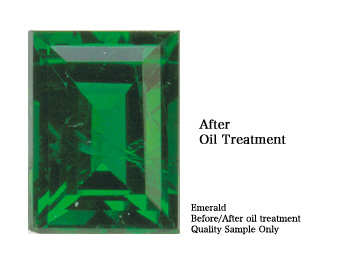
Fractures are fairly common in rough emeralds, and as many of these as possible are removed during cutting. Even so, fractures often remain as imperfections that detract from beauty. Because of this, making fractures less visible by filling them with oils that have a similar refractive index to that of emerald is a treatment that has long been used. In recent years, though, this treatment is being used in more extreme cases, and the reappearance of large fractures as the oil evaporates over time is becoming a problem. The use of polymers instead of oils to fill fractures, followed by hardening the polymer at the surface of the fracture, is also becoming common.
Untreated emeralds suffer more weight loss during the cutting process, making them more expensive, but they are valuable because their appearance will remain unchanged as long as they are not struck against something and damaged. Though they may appear the same at a glance, untreated emeralds are much more transparent than treated emeralds, a difference that is apparent even to the unaided eye when several of each type are viewed together.
Dealers often immerse rough emeralds in baby oil to make their insides more easily visible. After inspecting the rough, oil that has penetrated the fractures is removed by ultrasonic cleaning. Other than in this situation, untreated emeralds are never exposed to oils.When looking at the quality of emeralds and determining whether or not they are treated, it is important to have an understanding of the treatment process. It is possible to determine the degree of impregnation and the filling material used through scientific analysis with magnification and spectrophotometry, but treatment is still possible after such inspection, and the data contained in a laboratory report cannot be considered a guarantee.Even among gemstones such as diamond, ruby, and aquamarine, low-quality material with numerous fractures may be treated by impregnation with oil or lead glass. When coming across gemstones with especially low prices in spite of ad fine appearance, one should suspect fracture-filling treatment.

THE JOY OF
STACKING RINGS
Casually wearing fine jewelry on a regular basis shows a refined sense of style. When rings are worn together, they can be enjoyed in various combinations. The rings to the upper right are each slightly wider than two millimeters, about 0.1 inch. They can be worn individually, two or three of the same style can be stacked together, or a different style ring can be worn between tow of them-the combinations are limitless.
Band rings are also lovely when they are worn together with guard rings made of precious metal. For example, if the band-type emerald ring shown on pevious page is worn with a simple, two millimeter 18K yellow gold ring as a guard ring, its appearance will change dramatically, to a very modern look with more volume.
Thin band-type rings are also stackable with a main-stone ring. Especially if the main-stone ring is slightly loose, stacking it with a band-type ring will make it less likely to turn on the finger. Lately, main-stone rings with a construction that makes them easier to wear with guard rings have also been developed.
If possible, the resizing of band-type rings set with gemstones should be avoided. If made smaller, the prongs will spread open, making it easier for the stones to fall out. Conversely, making the size larger will cause the prongs to put dangerous pressure on the stones. If the size needs to be changed drastically, it is best to have the ring remade, even if it costs more. There is a limit to the range of sizes possible, but a competent jeweler should be able to use the materials effectively and remake the ring.