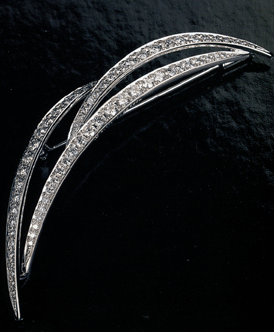
This brooch is completely free of unnecessary elements.
This platinum and diamond brooch was inspired by the image of an elegant plant, a representation of the natural beauty of reeds blowing in the wind. This subtle piece is so easy to get accustomed to that you might forget you are even wearing it. Unlike the extremely ornamental jewelry styles that might be described as “flamboyant” or “deluxe,” this piece takes a position among the exquisite and refined jewelry styles of 21st century.
This brooch is free of unnecessary design elements, keeping only what is essential. The decision to use diamonds instead of other gemstones is what makes the three lines of platinum representing the reeds appear so attractive. The diamonds are then arranged with large stones forming the central portion of the individual stalks, gradually decreasing in size as they approach either end. The effort that went into choosing these diamonds is obvious-inspecting numerous stones for those with matching face-up appearances and carefully arranging the, by size so that they graduate smoothly within the design, the expression of such simple beauty is made possible only through attention to fine details and a careful finish.
The creation of superior jewelry depends totally on the will of the producer. If a jeweler commits itself to making high-quality, exceptional pieces, it will (1) employ designers who are dedicated to the fundamentals, (2) take extra care in choosing and purchasing the raw materials, and (3) put production in the hands of talented artisans with proven skills, even if it means higher costs. On the other hand, if the producer’s primary concern is to lower costs, the results will be superficial designs, the use of lower-quality materials, and the handiwork of half-hearted craftsmen. If you are looking for comfortable jewelry that can be enjoyed over a long period of time, it is important that you carefully consider who you buy from.
As with the brooch to the next page, the one pictured below is a lively piece of jewelry that has done away with unnecessary elements. Two brooches like this one could be worn together in parallel, either vertically or horizontally, or in a V-shape, making a variety of expressions possible. Another characteristic of this brooch is its lightness, which keeps it from tipping over when being worn.

Brooch
Uyeda Jeweller
Diamond
900 Platinum
Size (mm): L 59 x W 4.0 x H 2.0
Bead-Set Diamond Brooch
Uyeda Jeweller
Metal : 900 Platinum
Total weight : 8.0 grams
Size (mm) : L 67 x W 10 x H 9.0
Diamond
Untreated
Gem Quality
THE QUALITY OF MELEE DIAMONDS
Regardless of a diamond’s size, the beauty of its brilliance is determined by the quality of the rough material from which it is polished. Diamond rough is produced by nature under the extreme temperatures and pressures that are present deep below the earth’s surface. These raw diamonds vary widely in shape, and none of them are absolutely perfect. Rough diamonds that are eventually used in jewelry can be broadly classified into three groups-sawable, makable, and cuttable (or near-gem). The shape and quality of the rough material determines the type of cut a diamond will receive, and also has a critical effect on the beauty of its finish.
A beautiful diamond is highly transparent and shines brilliantly. It shows a rainbow of dispersion when bright light is shined on it. A beautiful diamond sparkles with scintillation as it is moved, and has a fine overall appearance. The gem-quality diamonds below to the left exhibit beautiful brilliance, but the accessory-quality stones to the far right have a poor transparency that diminishes their beauty. Besides beauty, an important criterion of gem-quality diamonds is that they do not contain any imperfections that are discomforting or that have a negative effect on durability.
Gem-quality diamonds are valuable because they are far rarer than other diamonds, according for only 10 to 15 percent of all diamonds, and because most people simply prefer them. Comparing the relative values of two- to three-millimeter-size diamonds, and assigning a value of jewelry-quality diamonds would be 5 and accessory quality would be 1.
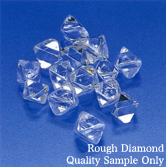
Sawable
This rough material most often appears in an octahedral shape, which resembles two pyramids joined together at the base. This rough, which is crystallized in a fairly orderly fashion, is characterized by its high transparency. Only 10 to 15 percent of all diamonds used as gemstones, including near-gem, fall into this category, and it is a valuable material that can be cut efficiently.

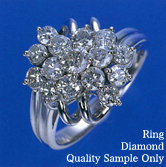
Makable
Makable rough varies widely in shape, and represents the medium-quality level of diamond rough. Each piece of rough is fashioned according to its shape. While even those with poor shape may end up as high-quality polished diamonds, some will only become low-quality diamonds that are lacking in beauty.

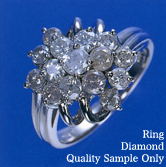
Near-Gem
Barely usable as a gem material, this type of rough was originally considered to be of industrial quality. Lacking in transparency, most of these stones contain large black inclusions or numerous fractures. Even after polishing, their transparency is low, and they exhibit almost no beautiful brilliance. Near-gem diamonds are used in low-cost jewelry.

BROOCH WEIGHT
This brooch does not give an impression of heaviness. Brooches must not only be visually impressive, but also lightweight. Creating jewelry that maintains an air of dignity while being lightweight requires a solid conception and expert skill. It is possible only through the work of skilled craftsmen who are committed from the onset to creating lightweight, comfortable, and beautiful jewelry.
This brooch is made with a thin band of platinum carefully welded to the outer edge of its platinum base. The basic shape of a handmade piece such as this is formed by hammering the individual pieces out of platinum as specified by the design.
When completed, the piece fit together perfectly, and it is impossible to even tell that the pieces were made from separate strips of platinum and soldered together. Such intricate handiwork can only be performed by someone with superior skill. Jewelry that combines quality and lightness like this cannot be created by simple casting the shape.
If lightness is the only consideration, then the piece can be made by electroforming or stamp pressing. Most jewelry made by stamp pressing is mass-produced using less precious metal in an attempt to lower costs, not to improve its functionality as jewelry by making it lightweight. Jewelry made by electroforming is hollow, and because the precious metal is thin, it is very easily crushed.
If force is applied and the metal is dented, it is difficult repair. It is important to understand that such accessories are only intended to be enjoyed as trend pieces.
If used carefully, this platinum and diamond brooch, made in the pursuit of lightweight perfection, will probably still be serving its purpose as a means of adornment even in the year 2100.
