Though the clarity and color grades of the diamonds in this necklace vary,
they are beautifully brilliant diamonds with matching faces.
This is as simple necklace with a beautiful sequence of diamonds. The diamonds are graduated in size, from 4.6 millimeters in the center down to 2.3 millimeters at the ends. The clasp is also set with diamonds, forming an uninterrupted line. Carefully finished to lie smoothly on the neckline, this necklace is comfortable to wear.
The diamonds in this necklace do not necessarily all have the same color and clarity grades, but they are all without defects and shine beautifully. These gem-quality diamonds with matching faces are carefully arranged by size so that they graduate smoothly. If even one diamond among these had a milky white color with low transparency, a poor brownish color, or a shallow cut that caused a “fish-eye” effect, the value of the necklace as a whole would be as good as gone. After all, no one would want to wear a defective product. While permissible to a degree in medium-grade pieces, the mixing in of materials that are not of the appropriate quality is a fatal defect for high-quality jewelry. In jewelry that is enjoyed for a continuous arrangement of gemstones, consistency of quality in the materials is of prime importance.
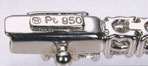
The bracelet below is a style called the “tennis” bracelet. Its name comes from the time when, in the late 1980s, the tennis player Chris Evert dropped a bracelet of this style that she was wearing on court during the U.S. Open. After that, this bracelet became popular throughout the United States, rapidly boosting the sluggish demand for 0.1-carat-sized round brilliant cut diamonds and reviving the diamond industry. Long ago, the masses copied the jewelry styles of royalty and nobility, but athletes and celebrities influence popular tastes in modern times

Bracelet
Mikimoto
950 Platinum
Diamond
Size (mm):L165 x W4.3 x H3.2
Diamond Line Necklace
Mikimoto
Metal : 950 Platinum
Total Weight : 35 grams
Size(mm) : L435 x W4.6 x H3.4

Diamond
Untreated
Gem Quality
TABLE SIZE
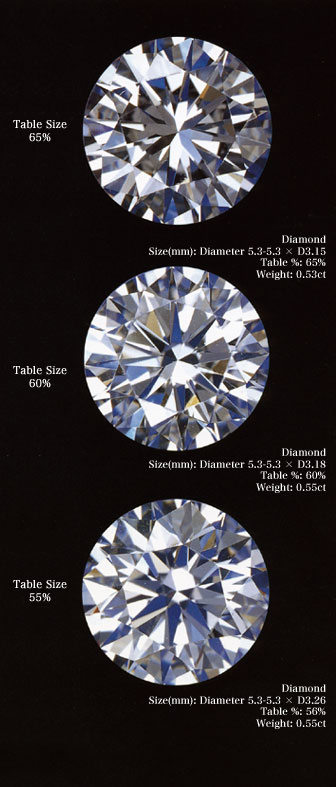
The table size of round brilliant cut diamonds greatly affects their face-up appearance. No matter how fine the material and how carefully polished it is, a single stone with a mismatched table size will detract from the total beauty of a jewelry piece.
Until the 1960s, the table size of modern round brilliant cuts was usually greater than 65 percent. In the 1980s, the number of those with tables of about 60 percent increased, and since the 1990s, diamonds with table size of about 55 percent (cut with high crowns) are seen in the marketplace. Small tables result in stronger dispersion, but brilliance is sacrificed. Meanwhile, larger tables have the advantage of making diamonds of the same carat weight look larger, and in Europe they are considered to have strong and beautiful brilliance. There is no table size that can be considered the absolute best- quality depends instead on the character that the cutter gives the diamond.
Some diamond grading reports include comments on the superiority or inferiority of a diamond’s cut. The optimum table size depends on how each diamond is taken advantage of in jewelry, so there is no need to be too particular about the cut grade shown in a report. Unless the table is extremely large or small, it is not possible to say whether the cut is superior or inferior.
TCONSTRUVTION OF
THE LINKS
This diamond line necklace was created by expertly soldering each link to the next in a manner that is similar to people standing together with their elbows interlocked. The method of connecting the links is very precise, making it necessary for the same artisan to complete the entire necklace. The links of the central two-thirds of the necklace are connected at the top, as shown in the bottom photograph, and they are connected in a way that allows the bottom edges of the links to open horizontally. On the other hand, the links at the ends of the necklace are connected in a straight line, as shown in the top photograph, and move in a different direction. The construction has been thought out to allow the necklace to lie smoothly along the lines of a woman’s neck.
Because the shape and size of each person’s neck is different, the necklace will not sit properly unless its length is just right. If the necklace feels uncomfortable, it needs to have its length adjusted.
If possible, a diamond line necklace that is 42 centimeters long (16 1/2 inches) should have a total of at least seven carats of diamonds. At that length, each link would be too small if the total weight of the diamonds were less than five carats, increasing the chances of the necklace turning over while it is being worn.
