There are standard uses for each fancy shape, based on the brilliance of its cut and the characteristics of its shape.
This ring has tapered baguette diamonds set on the shank to either side of an emerald-cut diamond. The base metal is hidden when viewed from above, and the transparency and crisp brilliance of the main stone give the ring a very sleek appearance.
It would be a poor choice to use brilliant-cut marquise or pear shapes on either side of an emerald-cut center stone, since such brilliant cuts tend to overpower the clear transparency of an emerald cut. On the other hand, if the center stone is a pear shape or a marquise, tapered baguettes on either side will enhance its appearance. In this way, the various shapes have their own generally accepted uses in gemstone-oriented jewelry, according to the characteristic brilliance of each cutting style.
Fancy shapes combine the elegance of diamonds with a playful character, and it is this free-spirited nature that makes them attractive.
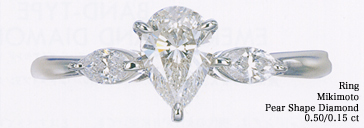
Marquise and pear shapes like those in the photograph below will appear larger than rounds of the same carat weight. When rings set with pear shapes are worn with the point facing toward the hand, the effect of the V-shape makes the finger look more attractive. The ideal outline for a pear shape is one in which a round diamond would fir perfectly in the top portion. When pear shapes are set in pendants, they are often set with the pointed side facing up and called “teardrops.”
Marquises have a sharp and refreshing shape. They look especially large for their size, and have a classic appearance.
Heart shapes are set in rings as solitaires. They are quite wide, and because their distinctive shape is more apparent when they are set by themselves, it is generally accepted that they are most beautiful when standing alone. Some people are passionate fans of the heart shape.
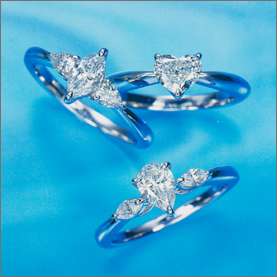
Ring
Mikimoto
Marquise Cut Diamond
950 Platinum
Size (mm): L 19 x W 8.0 x H 23
Ring
Mikimoto
Heart Shape Diamond
950 Platinum
Size (mm): L 19 x W 6.0 x H 21
Ring
Mikimoto
Pear Shape Diamond
950 Platinum
Size (mm): L 19 x W 7.0 x H 22

Fancy Shape Diamond Ring
Mikimoto
Metal : 950 Platinum
Total weight : 4.0 grams
Size (mm) : L 19 x W 5.3 x H 23

Emerald Cut Diamond
Untreated
Gem Quality
Weight: 0.54/0.21ct
SHAPE AND FACET ARRANGEMENT
The beautiful brilliance of diamonds is first brought to life when rough crystals of fine quality are given an appropriate cut. The final shape and facet arrangement are decided upon according to the shape of the rough and the current market demand. There are three styles of facet arrangement that are commonly used for diamonds: the brilliant cut, the step cut, and the princess cut. The photographs here clearly show that brilliant cuts and step cuts have a completely different brilliance, almost as if they were different gemstones.
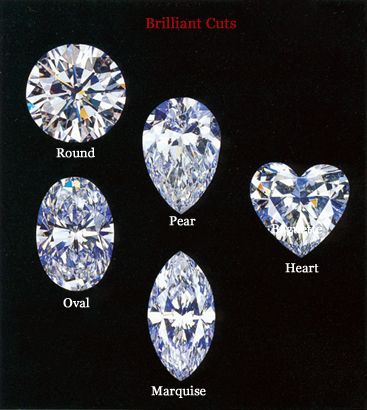
Brilliant cuts display a strong brilliance from inside. All of the facet lines on this type of cut radiate outward toward the girdle (outer edge). Starting with the typical round brilliant cut, common brilliant-cut shapes include ovals, marquises, pears, and hearts. The five shapes shown in the photograph are all gem-quality diamonds, but it is obvious that the round exhibits the most brilliance. This is because shapes other than round have different lengths and widths, as in the marquise’s 2-to-1 length-to-width ratio, resulting in the presence of areas that do not totally reflect light.
The beauty of step cuts, the most well-known of which is the
emerald cut, lies in their elegant brilliance and mesmerizing transparency. The name comes from the facets that are placed parallel to the girdle in a step-like fashion. Common shapes are emerald cuts, squares, rectangular baguettes, and small, trapezoidal tapered baguettes. Because defects are easier to see inside step cuts, they require especially high-quality rough material.
The princess cut succeeds in bringing out strong brilliance from a square shape. Introduced in the 1970s, it is a relatively new cutting style. Since the princess cut makes color appear deeper than the step cut does, this style is often seen in fancy-colored diamonds.


CHOOSING
SIDE STONES
It is most likely that the practice of putting marquises on the sides of pear-shaped center stones, using no side stones with hearts, and combining pear-shaped side stones with marquises all resulted from trial and error. In the case of combining pear shapes and marquises, the fact that both are brilliant cuts allows the combination to succeed without a sense of incompatibility, regardless of which shape is used as the center stone or side stones.
These styles are similar in concept to that of the solitaire. Though the diamonds on either side in the rings are side stones, it is as if they are a part of the shank. They tend to be subdued, and have a quiet, calming effect. Conversely, the three-stone ring that appears on page 106 is a dynamic ring that combines the beauty of three diamonds. Although both styles use three gemstones, their conception as jewelry is completely different. It is not a matter of which style is better or worse- by understanding the difference between solitaire, side-stone, and three-stone ring styles, the task of choosing jewelry that matches one’s own lifestyle becomes easier.
Though no longer common there once was a style of ring that featured a 0.3-carat (4.4 millimeter) round diamond with 0.05-carat (2.5 millimeter) round brilliants set on either side. This style in neither a solitaire, nor a style that enhances the shank with diamonds, nor a three-stone such a large difference in the degree of brilliance cannot effectively bring out the beauty of an arrangement of diamonds. Such a piece of inferior conception that simply throws gemstones together can only be referred to as rubbish.