Through small, each of these gemstones is different,
and their combination creates something totally unique
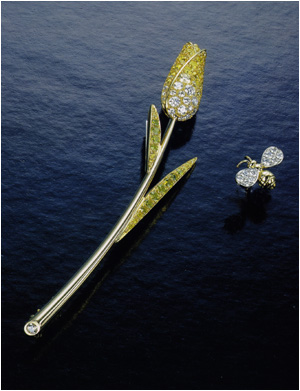
This brooch, glittering with pavé-set gemstones, represents springtime in a series entitled “Flowers of the Four Seasons.” The small yellow diamonds that are set in the flower of the tulip have a color of exquisite beauty that is the essence of a pure lemon yellow. Though a calculated design and careful make, each diamond if light and pure yellow-unblemished by any brownish color-contributes to the beauty of a creation that does not exist in nature. It is extremely rare to come across yellow diamonds as beautiful as these. Looking at this work frees one from the misconceptions that colored gemstones with deeper color and top clarity are of the highest quality, or that colorless diamonds are the best.
The leaves are made of demantoid garnets and very small round brilliant diamonds. A close look shows that extremely small diamonds are set all the way to the tips of the leaves. The little bee shown on the side looks as though it is actually buzzing around the flower net to it. The brilliance of the diamonds is fully displayed within wings that are crafted exceedingly thin to resemble an actual bee’s wings.
Because every small diamond displays its color differently, it is impossible to make two identical pieces like this tulip brooch. In many ways, this is what makes gemstone-oriented jewelry so attractive. The style can be duplicated, but each gemstone has a different nature, causing each combination to create something totally unique.
The photograph below shows a brooch that takes advantage of the delicate greed color of demantoid garnets. The inspiration for this brooch is the image of a dew-moistened leaf, lit by sunlight filtering through the deep spring foliage. Using gemstones created by nature, with a deep understanding of the character and beauty of the particular gemstone type, this creation fully expresses the beauty of a moment in nature. More than just a piece of jewelry, this brooch enters the realm of art. Though not shown here, there is a little ruby snail on the back of this brooch.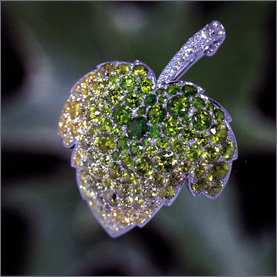
Brooch
Gimel
950 Platinum
18K Yellow Gold
Diamond
Demantoid Garnet
Sapphire
Size (mm):L39 x W27 x H15
Pavé-Set Tulip Brooch
Gimel
Metal : 18K Yellow Gold
Total Weight : 7.7 grams
Size(mm) : L75 x W9.0 x H7.0
Untreated
Gem Quality
Diamond
Garnets, which create the beauty of the leaves in the two brooches on the previous pages, come in a wide variety of hues. These include the reds of almandite and pyrope, the orange of mandarine garnets, the yellow-green to green colors of demantoid and tsavorite , and the purple-red of rhodolite. The tones of garnets also vary, with reddish garnets generally occurring in darker tones and greenish ones covering a wide range from dark to light. When a gemstone is used singly, tone of color has a large effect on quality, but when used in combination-especially when graduating colors-the balance of light and dark tones becomes crucial.
In the jewelry workshop, the mounting is made first, then the color scheme is decided on before the gemstones are placed in the bezels. Finding perfectly matching stones is extremely difficult. It is not uncommon for work that has been going on for a long time to be postponed because one or two perfectly matched gemstones cannot be found.

AJOUR
The brooch on the right, which contains mandarin garnets, represents the beauty of an autumn-tinted leaf in the sunlight. The combination of the garnets’ dispersion and the yellow diamonds adds a display of sparkling color. This is a beautiful expression of that moment when the leaf may fall to the ground at any time, and begin its final change to a deep purple-red.
The metalwork on the back of this brooch is worked in a honeycomb-like pattern, called ajour. Its purpose is to enable sufficient light to pass through the backs of the mandarin garnets and yellow diamonds. Each of the lines in the framework is cut deeply, leaving large openings. The metalwork is meticulously polished and all unnecessary precious metal is removed, allowing the weight of the piece to be minimized. Casting techniques are often employed when constructing a frame to allow more precision in areas such as the placement of the gemstones, the three-dimensionality of the piece, and its volume. The finishing process, however, is done totally by hand. When casting is used, there is the chance that unexpected pores may appear during the finishing process, making it necessary to start over from the beginning. Casting, though by no means an easier method than making a piece completely by hand, is a necessary part of creating the finest jewelry possible.
