Garnets are said to inspire in us
the vitality and energy to accomplish all things.
Rhodolite garnet was discovered in North Carolina in the United States in 1882. Garnets occur in many colors, and this variety is different from other reddish garnets. Its name is derived from the Greek rhodo (rose) and lithos (stone). The deposits in the United States were depleted by 1901, but around 1964, rhodolite was discovered in the Umba Valley in Tanzania, near the Kenyan border. In recent years, production from India has also increased, and it is possible that rhodolite will become an important gemstone in the near future.
The word garnet comes from the Latin word granum, meaning “seed”. In Japan, its name translates literally as “pomegranate stone.” Adoring oneself with garnet is said to bring about eternal friendship and trust, and to protect one from harm. Red garnets have a history of several thousand years, and garnet beads and inlaid jewelry were widespread in Egypt by 3100 B.C. In the 19th century, pyrope garnets from Bohemia in today’s Czech Republic were extremely popular. Pyrope garnets have a fiery red color, and because they are found only in smaller sizes, designs of jewelry using them are unique. The European bourgeoisie, born of the Industrial Revolution, would purchase these pyrope garnets while vacationing in the hot springs of Bohemia, and take them back to their homes throughout Europe. In his 1896 writings, Max Bauer notes that over half the merchandise displayed in jewelry stores at the end of the 19th century consisted of various types of garnets.
The beautiful purplish red of rhodolite is different from the classic red of almandite and pyrope garnet. Transparency is high, and material of medium tones is also mined. The rhodolite in the photograph to the next page is a beautiful stone of gem quality, with a purplish red color, a high level if transparency, and good shape and appearance. Polishers say that the quality of the rough material determines the brilliance of the stone. Any attempt to compensate for inferior quality by means of a good cut will result in a stone that lacks refinement and is not attractive. The natural beauty of rhodolite is therefore best brought out by a cut that is appropriate to the quality of the material at hand.
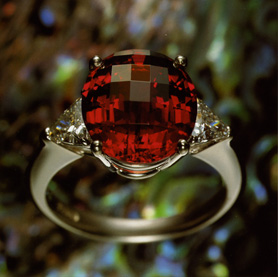
Ring, Platinum
Rhodolite1 pc
7.23 ct
Untreated
Diamond 2 pc
0.68 ct
US $6,500
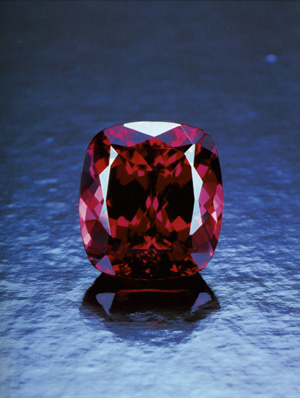
Name of mineral : Rhodolite Garnet
Mohs hardness : 7~7
Refractive index : 1.760
Specific gravity : 3.84
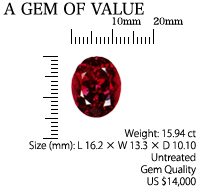
Weight: 16.82 ct
Size (mm) : L 14.9 x W 13.5 x D 9.48
Untreated
Gem Quality
TYPES OF GARNETS
There are many reddish garnets, but garnet may also be orange, yellow, green, or virtually any color other than blue. The different garnets vary in composition, refractive index, and hardness, and they belong to different mineralogical classifications. Here we will consider the garnets that are most commonly seen in the marketplace: almandite, rhodolite, and grossularite. Rhodolite is mined in Tanzania, Sri Lanka, and India, but there are no major differences in characteristics by county of origin.
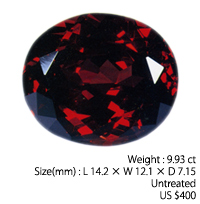
Almandite Garnet
Almandite has a red-brown color that resembles a dark ruby. Its major sources are Mozambique and Madagascar, but it is also reportedly found in Sri Lanka, Burma, India, Brazil, and Australia. Almandite is produced in large qualities and is generally sold in low-cost jewelry.
Rhodolite Garnet
Of all the garnets, rhodolite is currently attractive the most attention. When comparing gem qualities of almandite, pyrope, and rhodolite, one notices the purplish color, high level of transparency, and fine brilliance of rhodolite. Some rhodolite lack beauty due to a color that is too dark, but these should be thought of as accessory quality. Because the quality of gemstones can cover a wide range, it can help to think in terms of gem quality, jewelry quality, and accessory quality when making a purchase decision.
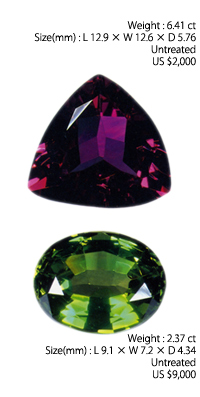
Grossularite Garnet
Grossularite garnet with a beautiful, clear green color is called “tsavorite” in the United States. Discovered in 1968 in the Tsavo National Park in Kenya, it has been promoted by Tiffany’s under that name. The attractive green of tsavorite has been compared to that of emerald, but this gemstone’s drawback is that it is produced in small quantities. The limited popularity of grossularite can be understood when compared to diamond, which gained widespread acceptance largely due to a constant supply in sufficient quantities for it to find its way to many people.
JUDGING QUALITY
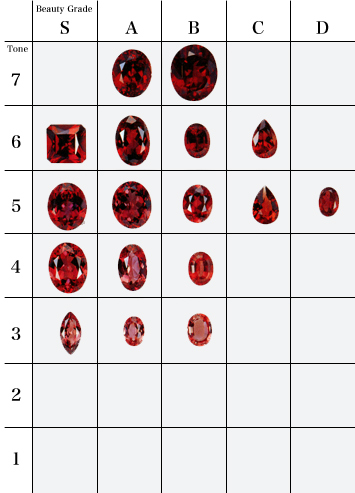
The quality of rhodolite is judged by its purplish red color, high level of transparency, and medium tone. The red in rhodolite is different from the red in ruby. Purplish red is not desirable in a ruby, but it is the most important consideration in the beauty of a rhodolite. Regarding transparency, a rhodolite should have few needle-like inclusions, and the material should not have a silky or cloudy appearance. A deep red rhodolite will lose its beauty if it is too dark. A rhodolite of gem quality will have a medium tone of purplish red, with high transparency and a good shape and appearance.
Stones that are too dark (tone 7), brownish stones, and stones with poor transparency will get a beauty grade of B, and are considered accessory quality. Stones with a tone of 3 are light because of a shallow cut; the tone of the material itself is actually darker.
As when viewing other reddish gemstones, it is especially important to judge the quality of a rhodolite while observing the stone under natural light.
QUALITY SCALE
RHODOLITES
Untreated
HOW TO CHOOSE
Rhodolite is a reddish gemstone with abundant beauty. People familiar with rhodolite develop a taste for purplish red colors, because purple is a requirement for gem-quality rhodolite. A gem-quality rhodolite of 3 to 5 carats can be purchased for a relatively reasonable price. A standard price for a 5-carat gem-quality rhodolite would be about $2,000, but a ruby of 5 carats could not be purchased even for $10,000. Considering this, it can be said that the $2,000 for the rhodolite is a bargain. However, rhodolites of accessory quality cannot be recommended because they lack the beautiful purplish hue.
The value of a three-carat-size rhodolite of jewelry quality is approximately US $250 for the stone alone (2004).
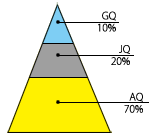
The 3 quality zones as they appear in the quality scale
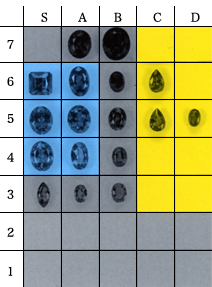
Quantity distribution of gems that are polished to 3-carat size
| VALUE INDEX | ||||||||||||||||
| ||||||||||||||||
 | ||||||||||||||||
|