When discussing gemstone cutting, it is necessary to have an understanding of three important factors: tradition and advances in polishing technology, the quality of rough material, and the cost of polishing gems. Answers to questions such as, “Why do antique jewelry pieces use rose-cut diamonds?”, “Why is this ruby fashioned as a cabochon?”, and “How […]
When did mankind first start mining gemstones? In Chapter 1 we touched upon the history of 24 gems, but it is easy to imagine that substantial unrecorded mining has also taken place throughout the ages. Once gems formed by volcanic activity have been pushed upward to the surface by shifts in the earth’s crust, wind […]
Rough gemstones were created by the forces of nature between 3 billion and several tens of millions of years ago. Over the mind-boggling number of years since their formation, some crystals happened to be transported to near the earth’s surface through shifts in the earth’s crust. Such crystals are then mined and polished, becoming a […]
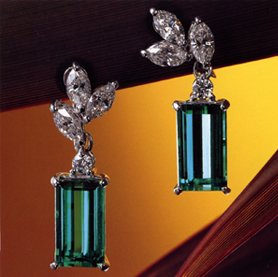
This is a very new gemstone, a magnificent and beautiful material with a color that is referred to as “fluorescent” blue. There is just one reason why Paraíba tourmaline, new on the scene and with unstable production, is included in this book-its rare and unmatched beauty. The state of Paraíba in the northeastern corner of […]
This greenstone, said to calm the soul, symbolizes good health. Though once mistaken for emerald, it lacks that gem’s long history and lore. Tourmaline is found in all colors- red, orange, yellow, green, blue, violet, and purple- and exceeds even corundum (which includes ruby and sapphire) in variety of colors. By the beginning of the […]
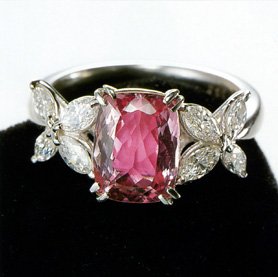
Topaz is said to foster friendship, and pink topaz symbolizes tenderness and cheerfulness. Topaz has been used as gemstones since the days of ancient Egypt and Rome. However, it seems that it was not very popular during the Middle Ages, since there are no accounts of it from that era. In latter times, the French […]
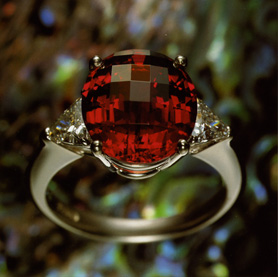
Garnets are said to inspire in us the vitality and energy to accomplish all things. Rhodolite garnet was discovered in North Carolina in the United States in 1882. Garnets occur in many colors, and this variety is different from other reddish garnets. Its name is derived from the Greek rhodo (rose) and lithos (stone). The […]
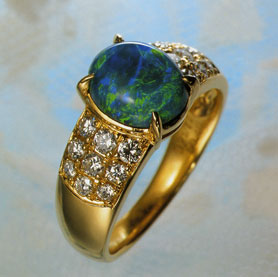
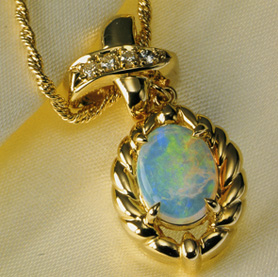
With a history of less than 100 years, black opal’s greatest appeal lies in the fact that each one possesses a totally unique beauty. As long ago as ancient Roman times, light opal was found in high qualities in northern Hungary. In contrast, black opal was only discovered in 1902, at Lightning Ridge in the […]
Enchanted by the beauty of its dazzling colors, the ancient Romans considered opal the gemstone of love and hope. The name “opal” comes from the Latin opalus, meaning “precious stone,” and ancient Romans thought of opal as the gem of love and hope. The ancient Roman writer Pliny observed that it is as if the […]
Among brilliantly shining diamonds, melee can play a supporting role to other gemstones, or a number of them may be set together to become beautiful jewelry. “Melee” refers to small diamonds of less than 0.2 carats, and these are considered separately from other diamonds. Melee diamond is used in jewelry that is designed with several […]
In Europe, it was said that this gem made the wearer more eloquent. Perhaps we could take note of this in modern society. The mineral olivine sometimes occurs as a gemstone of an olive color, a green mixed with yellow and brown. The more precious of these stones are called peridot. The historical source of […]
Created by marine microorganisms, each piece of coral has its own unique character. In Scotland, there is a saying that coral brings beauty and prosperity to young girls. Coral is neither plant nor mineral, but rather a product of microorganisms that live in the ocean. It is composed mainly of calcium carbonate-the same as the […]